The Omega Consensus was intended to bring hope and provide a blueprint for a better tomorrow. Instead, it became a weapon—twisted, silent, and deadly. Blackmail runs through its veins. Greed drives its pulse. No one knows how long it’s been compromised. No one’s talking. Oil prices spike. Fingers point. And in the shadows, Al Amorta Ujung waits—an extortionist syndicate with its sights set on the throat of the United States. They don’t want money. They want control. And they’re willing to burn the world to get it.
Monty and McCluskey present their novel, Omega Consensus: No Tour Guides in Hell, on this website in serial form free of charge. Follow and be sure to subscribe so you’ll get notice when new chapters are published. The Prologue and several chapters are live now and we’ll post two chapters each week.
Enter your email to receive updates, then be sure to check your email to verify your email address.
The clinic used to be a Minangkabau family home. Brightly painted wooden moldings and colorful glass pieces topped the building. Objadu and Erik tiptoed around, hoping Dortha wouldn’t notice them.
“She’s eager to eliminate any hint of fun,” Erik told his young protégé. “Dortha’s an old sourpuss.”
“She is almost as dear to me as my mother,” Obi said. “But I’ve seen her scold an Al Amorta soldier until his tears flowed.”
“She has that effect on people,” Erik said. “So, are you really planning to flee? I see you’ve stashed your gear in the weeds by the pond.”
“You saw that? And you said nothing?” Objadu sighed. “I suppose that soldier saw it too, then. Perhaps I should kill him before he can report me.”
“Those are disturbing thoughts for a Minangkabau youth,” Erik said. “Perhaps you should share this with your father. Or consult your mother. Wisdom seems to be a woman’s domain.”
“That’s what my mother says.” And he laughed at the old man. “What if I were to ask for a Merantau? My Uncle did it many years ago; he never came back.”
“Yes, Chandrah. He was a good young man, but he was captivated by the outside world. He broke your grandmother’s heart and your father’s as well. It’s a Minang’s right to go on a journey of self-discovery, but one is expected to come back.”
“I don’t want to hurt my parents or my grandmother,” Objadu replied. “But I don’t want to grow old in this place, either.”
“Such deep thoughts,” Erik said. “Listen. It’s so quiet. The young ones are napping. Why don’t we play a game of shuffleboard? We’ll discuss this some more, Obi. I can see the heat of emotion weighing you down. It’s a bad time for decision-making.”
“Do you think they have shuffleboard tournaments in London or Paris?”
“If I were in Paris, I’d be sipping a fine wine and eating quail stuffed with truffles,” Erik said. “I’d visit the Eiffel Tower and drink espresso on the Champs Élysées. But my real dream is to play shuffleboard in Miami. Just another old codger with artificial knees living for the next game of checkers in the park.”
“You want to live in the country that abandoned us? The ones who left us at the mercy of these soulless men claiming a religion of nameless gods who permit murder?”
“Son, I wish I could tell you that some other country is better and its motives are purer, but that’s not true. There probably isn’t a finer flag to pledge your allegiance to.”
“These thoughts weigh heavier than the air.” Obi hugged the old man. “Let’s play our game. I’ll wager a glass of lemonade.”
“Maybe you could retrieve your luggage from the pond. You’ll probably find your big fish inside,” Erik laughed. “We need to be stealthy. If Dortha catches us, she’ll ruin the day.”
Inside the clinic, Nurse Dortha Myers was flipping through Mature Bride magazine while the printer churned out a thick stack of paper. It was usually bad news—either the Al Amorta had a new rule, or the Americans were demanding more clones. Either way, she didn’t want to deal with it.
“Look at this,” she said, since no one was there to hear. “I could have a real wedding gown, even at my age.” The magazine featured a gray-haired bride who looked quite elegant in a simple, satin sleeveless gown. She leaned back into Erik’s chair and spun around lazily. The printer kept spitting out pages.
“Blast them,” she mumbled, and stashed the magazine in the drawer. She raised the blinds and looked out the window. The orangutans were kiss-squeaking in the enclosure, so Erik was nearby. She leaned out of the screenless casement. In the distance, she saw Erik and Objadu walking toward the shuffleboard court.
Another victim, she reflected. Poor Objadu. I hope he doesn’t have any money on him.
She grabbed the ream of paper that had fallen to the floor and tore it away from the old printer that had finally stopped its frantic clacking. The data was double-spaced.
Sanctuary Updates:
Meningitis Alert: Clone susceptibility to protozoan infection is deemed a credible threat. Check water supplies for contamination.
Clone Status: E20098 issued to NASA, Houston, Texas, assigned name Barnaby Stowbridge.
E19865 reported working in Chicago at Loyola Medical Center as a microbiologist and delivered a bi-species child on August 4.
E20028 was issued to Hoffmeister Institute for Genetic Studies, deceased under suspicious circumstances.
Dortha Myers had cared for every young person raised at the complex over the years. Her blood ran cold at the thought of any clone child’s death. And E20028 would be a child around six years old. It was a baby she’d looked after from its beginning to the day he or she was launched into the world.
“E20028,” panic gripped her. “Who is that?” Dortha hurried to the filing cabinet, flipping through the folders. When she found the number, she hesitated to look. Like a mother whose child’s school bus has flipped over, how do you search through the wreckage? But she finally looked.
“Azara,” Dortha’s tears traced her cheeks. She remembered the day she had lifted the little girl onto her knee, explaining to the adorable two-year-old that mommies and daddies were meant for very special children. Azara looked into her eyes with such longing that Dortha felt all the love her barren soul could give.
Then Azara said, “Could you be my mommy?”
She did know E20028. She knew every scrape and bump, whether on her knees or her head. She knew how she spat her broccoli back onto her plate.
“How?” Dortha felt crushed by the weight of her sorrow; her mouth was dry and her tears hot. And the questionable circumstances stood out like a beacon. She ran back to the printout and looked further down the page.
Updates:
E19985 deceased, protozoan meningitis.
E20028 deceased, issued to Hoffmeister Institute: this fake organization is a front for Senator W. Willson. CIA reports this child was involved in extortion payoffs for a known criminal. Pathology results pending.
E14556 deceased, protozoan meningitis.
Over the years, Dortha had held children in her lap and secretly fantasized that they were the result of tender lovemaking. Maternal instincts, brought to the surface by these parentless clone children, filled her empty and barren life. Now, Azara, who left the compound as little more than a baby, is dead. And for what unholy purpose was she sacrificed?
Dortha activated the compound’s sound system with a flick of a switch. The squeal of feedback deafened the soldiers in the tower directly above the speaker.
“Erik, come to the clinic, please.” Her sharp voice echoed through the complex, bouncing off walls, trees, and buildings.
“Ah, we’ve been caught,” Erik grimaced. He grabbed his cane and left Objadu to finish the game alone. “The bitch has beaten me!”
Dr. VandenHeuvel hurried as fast as his old legs could go, grumbling all the way. Obi had just won the last of his pocket change, and the day was taking a turn for the worse.
“It’s probably Malof. Dortha knows what to do,” he growled. “She just doesn’t want me to have any fun.
I wonder — he’s had a headache since Monday, and now he has a fever. Maybe I should do a spinal tap. Ah, but that’s so invasive for a little one.
Erik looked up at the clinic window. Dortha was standing there. Usually, when she was angry, she crossed her arms and looked like a tyrant. Now, she appeared like an old woman with a broken heart. This was a sign of bad news.
Erik hurried, something he rarely did for anyone these days. His once-black whiskers were now white and snowy, forming a halo around his head. The children compared him to Santa, and in a way, they truly were his children.
He passed by the orangutans, who watched him from behind the fence of their arboreal enclosure. They sounded like rabble threatening to overthrow their king. Natagna was once again defending his status as alpha male.
A stream running through the reserve supplied fresh water for the Omega Project’s Pongo pygmaeus population. The orangutans lived isolated from the rain forest; nearly one hundred of them were spread over thirty-five acres of enclosed forest preserve.
It was feeding time, a noisy part of the day. Manu, Objadu’s father, opened the access door and poured fresh food into the feeding area. Natagna held his durian fruit in the air and let out a call that could be heard for several kilometers. Nearby children echoed Natagna’s cry as if they were his backup singers.
Erik opened the door where Dortha was clutching the windowsill.
“What is it?” the old doctor asked. “Has something happened?”
“Read that printout over there. It’s Azara; she’s gone.”
“Gone?” Erik said. “She left years ago. Have you lost your mind?”
“Dead, Erik. She’s gone. Some Senator used her as part of a blackmail scheme, and the extortionist was a known criminal. We sent her to a terrible death, God knows. And I think I understand what’s wrong with Malof.”
The old man’s pain knew no boundaries, nor did his rage. …………………………………………………………………………………………………………………End
Enter your email address to receive email updates as new chapters are added. Be sure to check your email after to confirm.
Objadu crouched in the weeds at the pond’s edge. The heat was intense, and the smell of burning vegetation thickened the air. The young Sumatran pretended not to notice the reflection of a soldier in the water. The terrorist sat atop the wall behind Objadu. The crack of a rifle and the orangutan’s cry confirmed that Al Amorta’s ammunition was live. Objadu listened for the thud of another noble creature being taken out by Jah Lo’s men. The soldier chuckled, gloating over his kill. Objadu wanted to take him out for good.
It’s a crime, Objadu thought to himself. While children play nearby, they kill innocent animals. To the youngsters, gunfire was a common part of the rainforest symphony.
The children’s laughter filled the air as they played beneath a massive acacia tree, nestled in the mountainous region near Padang. The Omega Compound, rich in Indonesia’s mysterious culture, featured houses built like exotic, stilted hats.
Erik VandenHeuvel leaned on his cane as he made his way toward Objadu. The soldier looked down at the old man, then turned away to survey the jungle floor.
Two kids twirled a jump rope while a little girl’s singsong voice filled the air. Amarh’s red curls bounced in time to the brisk rhythm. Dr. VandenHeuvel paused to watch them.
“Down in the valley, where the green grass grows, there sat Amarh, as sweet as a rose. Along came Malof and kissed her on the nose. How many . . .”
Amarh’s feet caught in the rope, and she fell into a giggling heap. The others followed suit, laughing along. After handing out a handful of candy, Dr. VandenHeuvel limped over to the pond.
The young Minangkabau native and the old Dutch doctor represented a clash of cultures. Objadu pushed the canvas bag further into the rushes. Nothing the old man said could stop his upcoming flight.
Dr. Erik settled onto a bench in the shade of a durian tree at the water’s edge. His escape plans consumed Objadu, but he tried to act nonchalant. The children still played nearby, but neither man paid them any attention. An Al Amorta Ujung soldier swung by, making another tour of the wall, and stopped briefly overhead. The silent vigil continued until the intruder tired and moved on.
“I knew I’d find you here, Obi,” Dr. VandenHeuvel’s tone was conspiratorial. “Your father said you’re eager to make a water garden.”
“Is this as close as I’ll ever get to freedom? The edge of these walls?” Then, seeing the old man’s pain, he recanted. “I’m sorry, I know this was a dream for you and my father, but it has become my nightmare.”
“I agree with you, Obi. When your father and I found this site, we both said, at the same time I believe, that we would build our clinic here.”
Objadu stifled a yawn. The heat of the sun made him sleepy. He’d heard this tale at least a thousand times.
“Now we are prisoners of the Al Amorta and their foolish two thousand gods. None of us can understand how we ended up prisoners in our own country.”
“It all started when . . .” The old man droned, and Obi sighed. There would be no escape from this retelling. “I was tracking an orangutan family, tagging them for study.”
“And this was a Catholic school?” He humored the old man out of love.
“Missionaries constructed it during the Dutch occupation.”
“I have heard many stories about those times,” Objadu looked away; it was hard to hide his feelings from the old doctor.
“The English were quite rude, and the Dutch were even worse. It was not a proud moment for my people. We built this research facility in 1952. You weren’t even a sparkle in your father’s eye.”
Obi smiled. It was a strange thought to imagine his parents in the middle of passion.
“I wanted to study the orangutan with the help of your people. In return, I would provide medical care. Our biggest mistake was trusting outsiders. First, it was the Americans. They weren’t so bad. Then, when they discovered my identity, they used us. Soon, Al Amorta came along and used them.”
The old man looked up with a menacing glare at the soldier walking the wall. “Two thousand gods, indeed.”
“The Americans certainly haven’t paid the price we have,” Objadu said. Erik could see he was a very angry young man, just as Manu had warned.
“It’s about oil, Obi. Americans will do almost anything for what they call black gold.”
“If you lie down with pigs, the smell gets on you.”
“You are so right,” Erik said tiredly. “But we never seem to realize that at first. Now, we’re in a tight spot.”
“You can’t reason with fanatics,” the younger man said. “You just have to wipe them from the face of the earth.”
“Omega began as an ambitious mission. The Americans said they supported technological progress to benefit the world. They provided funding, and we enjoyed our good luck.”
“In truth, we built our own prison.”
“It is said, Obi, that we are ultimately our own jailers. We tend to think the enemy of our enemy is our friend. More likely, the enemy of our enemy is also our enemy. When that band of terrorists discovered the Americans were cloning people, the response of the great United States was to get in bed with them. That was doomed from the start.”
“One of the soldiers told me that they believe their two thousand gods have named them as the chosen people. The Al Amorta Ujung are no more chosen than the Jews, Christians, or the martyrs who die in the name of Islam.”
“No man is above another. Even now, the Americans won’t recognize the threat the Ujung pose to the world. Al Amorta Ujung used American dollars to build their empire. They have enslaved their own people.”
“Is that really any different from what the Americans do? They enslave the clones in Sanctuary.”
“Not all of them. Some have been integrated into outside lives and don’t even remember us, Obi. Mind control is a magical science.”
“Magical? Or maniacal?”
“Perhaps both,” Erik conceded. “But American corruption cannot compare to the evil deeds of Al Amorta Ujung. They condemn Western culture and commit atrocities in the name of their many gods. Their master plan is to sway Indonesia and then the world away from the teachings of Muhammad.”
“But Islam is the foundation of Indonesia,” Obi said. “The Western world decries Islam at their peril. The Al Amorta makes the most fanatical Muslim seem as meek as a lamb.”
“You must be very careful, son,” Erik warned. A soldier was approaching, and he seemed very interested in their tête-à-tête at the pond. “They have sophisticated equipment, and they can listen to our conversations from a great distance. We must be stealthy to outfox the Al Amorta.”
Obi looked up to see the soldier spit deep into freedom on the other side of the wall.
“If it weren’t for the American lust for oil,” Objadu said, “the Al Amorta would have no power.”
“It’s the way of the world, Obi,” Erik said. “We can send a man to the moon, but an engine that runs on something other than fossil fuel seems out of the common man’s reach. Electric — not convenient enough. Recharging stations are few and far between. No one has a one-hundred-mile extension cord,” he chuckled. “Fuels from plants? Other than corn, the creators seem to always meet with foul play, or something blows up somewhere mysteriously.”
“It’s blackmail,” Objadu insisted. “If the Americans hadn’t dabbled in cloning, they wouldn’t be paying the Al Amorta extortion rates for oil.”
“Jah Lo’s men have become unbearable. The guards wear those silly camouflage uniforms, as if clothing alone could help them blend into the rainforest like chameleons.”
“Sometimes, in my dreams, I dive into the pond. I’m a fish,” Obi said.
“A huge fish,” Erik chuckled.
“And I swim through the culvert to Freedom. Nobody notices.”
“Nobody except the Al Amorta soldier who fries you up for dinner, Obi. This is all my fault. Now, the Americans send for children before they are old enough to leave. I lose track of them. It was never my intent to lose the children.”
“What I wouldn’t give to be free—I’d give my very life.”
“A man is never truly free,” Erik said. “After climbing a great hill, one only finds that there are many more hills to climb.”
“Did you make that up?”
“No, an old gentleman named Nelson Mandela did. He concluded that thought by saying that he dares not linger, for his long walk is not yet finished.”
“Profound ideas,” Obi agreed. And they walked toward the clinic, shoulder to shoulder, an elderly doctor burdened by regret and a young man hoping for an opportunity to accumulate some. ………………………………………………………………………………………………………………End
Enter your email address to receive email updates as new chapters are added. Be sure to check your email after to confirm.
“Hey, what’s up, Hank?” Barney Deters had one of his bad feelings. “You’ve been smoking like a house afire. Everything okay?”
“Sure,” Hank replied. But Barney could tell it wasn’t true. Whenever Hank went silent, trouble soon followed.
“You look like someone took a dump on your petunias,” Barney eyed his friend. The worried expression was troubling. “You miss Blanche? She’d be sore at you.”
“Christ, Barney. You can’t have the love of your life gradually fade away and then suddenly act all cheerful like Happy the Clown.”
“That was over five years ago,” Barney said. “I think you can stop wearing black now.”
“It’s my Johnny Cash look, ok?” Hank said. “Five years? Has it really been that long?”
“Every day of it,” Barney said. “I loved her, too. We all loved her. She made one hell of a lemon pie.”
“Change the subject, Barn. I don’t want to talk about this.”
“Okay, let’s discuss dead kids,” Barney said.
“Mark my words, every dip-wad reporter this side of Lansing will be out here before supper.” Hank stared out the window. Barney wondered if Hank was tearing up.
“I hope Steve had enough sense to secure the scene. He doesn’t have much experience.”
“He’ll be okay. He was at the top of his class at the Academy.”
“I meant to talk to you about that,” Barney said. “I checked his references, and he didn’t attend the one he listed. I’m going to pursue that bit of information.”
“I saw his certificate,” Hank frowned. “He even has a picture with his graduating class stuck inside his locker.”
“Oh, good. I was getting a hinky feeling about the whole deal.” Barney plucked his grandpa’s silver shoehorn from his shirt pocket and waved it at Hank. “We’re going to need tools, so I brought this.”
“Do you even have a procedural manual?”
“Shoehorns are handy, my friend. You can dig with them or even eat a bowl of chili when you’re in a pinch. Come to think of it, you can even scratch your backside with one. Like I was saying, Steve claims it’s a child. I was hoping for a tiny adult or a leprechaun.”
“That is an insane notion, Barney. What have you been putting in your coffee?”
“Well, shit. Whiskey. Make it anything but a child. It is just a nightmare. A dadgum hellish thing. My heart hurts, Hank.”
“To be precise, he said it was a head. Who’s to say the rest of the body is even there?”
“That’s gruesome, even for you.”
“I’m hoping the rest is buried. Bad enough as it is without imagining a damned baby head rolling around the countryside,” Hank muttered. The parade of farms flashed by. He knew every person by name. “Did Mike plow it up with a cache of turnips?”
“Nope. Amelia said little Maggie found it. She went out to burn the trash,” Barney wheezed. “Then she came running back to the house like she’d seen the Devil himself.”
“Poor kid.”
“It’s a goddamn shame. Had a dirty ribbon she’d pulled straight out of the dirt. The tassel of hair came right up out of the soil. Poor kid thought it was a horse’s tail.” Barney screwed up his face like he did when something gnawed at his guts. “Mike said he just couldn’t bring himself to believe it was a person, and it did kind of look like a horse’s tail.”
“Nothing unusual about livestock turning up dead around here.”
“Well, it might seem a little strange if it wasn’t your livestock.”
“True,” Hank inhaled and let the nicotine soothe him. “Very true. And we still must consider what Esther VanderLaan said earlier today. What was Mike doing at the cemetery last night?”
“What was Fly doing riding his bike at the crack of dawn?” Barney countered.
Taking a right, they drove down the rutted driveway that runs along the western edge of O’Bryan’s property.
“I don’t relish having a case of mysterious cadaver on our hands,” Hank admitted. “Brings the nuts out of the woodwork, psychics and shit.”
“Every crackpot’s going to be hunkered in our lobby. Not to mention the psychos who want to have a look-see.” Barney spotted something on the side of the road; an opossum’s remains lay in a death curl. “I love roadkill. That’s the only kind of cadaver I want in my jurisdiction.”
Barney carefully drove the patrol car through patches of turned soil, scraping the muffler on fallen branches. The rear wheel skidded on the loose dirt before slipping into a crevasse and getting stuck. He stepped out to check the buried hub, while Hank sniffed the air.
“Smells like you parked on some good old American cow shit to me.” Hank grabbed his equipment and made his way to safe ground. “You’ll notice that Steve had the good sense to stay on the road. This could work out, though. Wait till you get a gaggle of news hounds and then floor the son-of-a-bitch.”
Barney was not laughing when the state police car pulled in, tried to go around them, and got stuck on another mound of dung. Sergeant Elmo Carter stepped out, none the happier.
“What’s the matter, Carter? Are you stuck?” Barney grinned.
Elmo muttered a few curses.
“You seem like a man with a hot foot, Elmo. The body isn’t going to get any deader!”
Elmo tripped over a rock, picked it up, and heaved it into the ditch. He stood at least six-four, dwarfing his colleagues. A menacing frown replaced his usual pleasant nature.
“Tread lightly, Deters,” Elmo Carter said. “I’m in a terrible mood today.”
“Who called the State Boys?” Barney shouted as his foot sank into the dark loam. “Aw, shit. Who called you?”
“Don’t know.” Carter quickened his pace.
Hank followed them, wondering if he might have to be a witness when they fought each other. Then he noticed people standing at the tree line, watching. He wandered over.
“Can I help you?” he asked because the woman was nearly beautiful and clearly out of her element.
“I’m Hallie Ruben, from WQIP,” Louey said. “This is Marlin Fishbrain.”
“Martin Fishbein,” the youth corrected. “I’m an intern.”
“I’ll just bet you are,” Hank said. “Listen, we need to preserve this scene. Could you go back to the road, Miss?”
Hallie felt like a schoolgirl. She thought he had nice eyes. He turned and walked away. Then he looked back at her for no good reason.
She grabbed Martin’s arm and guided him toward the road.
“Come on, Marlin,” she said. “Do what the man says.”
“Are we getting in on this or what?” Martin asked, earning himself an extra twist that almost took his forearm off his elbow.
“You need to learn to play nice, Martin,” Hallie hissed. “If they take a dislike to you, you’re shut down in no time.”
Mike O’Bryan sat atop his horse, talking with Brooks. The clearing was an oasis from the scrub of the fallow field, with loosely turned dirt and deadfall piled in the middle.
There was a burn barrel, or at least part of one. One side had collapsed, spilling incinerated trash debris from its yawning, rusty top. The area was marked with bright yellow crime scene tape.
Even a novice detective could identify the tracks: horse’s hoof prints and a small child’s bare feet. Along the eastern edge of the circle, there were indistinct prints of a man’s right shoe and a bare left foot. Branches had been dragged across the area, but the prints remained clearly visible in the soft dirt.
“Who cordoned this scene?” Carter asked, interrupting Steve’s first real police interrogation.
“I did,” Steve shot back. “Who’s working on this anyway? I thought it was ours.”
Barney joined the debate, still panting from the chase.
“It’s within the city limits, Elmo. We incorporated Wisteria Township last year. This is our turf.” He bent over, gasping for breath.
“Damn it, Deters.” Carter kicked at the loose dirt. “I’m just following orders.”
“That’s way more interesting, Elmo—since O’Bryan only called us about twenty minutes ago. You guys are more than an hour away.” Barney looked at the officer suspiciously. “How did you know there was a body here if Maggie hadn’t found it yet?”
“Why don’t you call one of those Psychic Hotlines and ask them?”
Hank looked at Barney, whose face was turning redder by the minute. The old man was about to lose his temper.
“You involved in this, Elmo? This doesn’t even make sense. You had to get a call before the body was found. What aren’t you telling us?”
“I don’t like your tone,” Elmo snarled. He got the call while he was at a meeting in Lansing. That was at seven this morning. His report would say it was anonymous, but it had come from the governor’s office. His instructions were clear: go to O’Bryan’s place, find a body in the clearing, and make sure a man from the state crime lab has access.
“That’s shady, Elmo,” Barney shot him a dirty look.
“You questioning my integrity? I think you know me better than that, Deters.” Elmo’s voice was menacing as he towered over the Chief.
“Uh, excuse me, fellas. Can I go home now?” Mike’s horse was uneasy. It pawed at the loose dirt. “This guy is ready for fresh hay.”
Getting no response, O’Bryan lifted the reins and headed back to the barn.
“Stay at the house, Mike,” Hank called after him. “One of us will be over later.”
Barney watched Mike’s face. He seemed nervous, maybe more than someone who just stumbled upon a dead body in his field should be. This whole situation was going to get uglier before it got better.
“Okay, you two prima donnas, let’s get to work.” Hank, always the peacemaker, clapped both Elmo and Barney on the back, breaking the tension. “You’ve been friends for a long spell. Let’s dig up this poor kid, and you two can fight over who owns the case later.”
Steve had covered the gruesome scene with a blanket. As he moved it away, Barney took his first deep breath in years. Hank was caught off guard by a swarm of bees that was suddenly released into his head. Then, the dizziness passed.
A shock of coarse red hair was tangled next to the child’s head. Her eyelids were slightly parted, and dirt particles dotted the whites of her cloudy green eyes. She stared at the sun, unblinking.
The men shared a quick glance. Hank shrugged and took off his shirt. The hot sun warmed the cold sweat he’d broken into. He tied his red bandana around his head to keep the flow of sweat down. Then he grabbed a shovel and carefully started digging around the head where Steve had left off.
Working silently, he loosened the soil while Barney and Elmo scooped it carefully away from the body. She had died too recently for decomposition to distort her peaceful face. They bagged the soil to sift through later.
After what seemed like forever, a little girl’s bare body lay exposed, her long burgundy hair spread around her like a shroud. Black soil clung to her skin, making her appear even paler than she had in life.
Steve took pictures with the thirty-five-millimeter camera. By late afternoon, news reporters from Detroit lined the shoulder of North Territorial Road.
Hank lit a cigarette. His hands were covered in dirt; streaks of tears ran down his tired face. Barney stood silently, thinking that the world was definitely a dangerous and ugly place.
Alec Golden, the medical examiner for Washtenaw County, arrived just after four o’clock. He was seventy-two and had long since retired from family practice in Ann Arbor. Doc was a sharp man. Although he might have lacked sophistication, he made up for it with common sense. Using his clear-headed analytical skills, he had corrected more than a few police officers’ missed observations.
He began examining the body by stabbing the lifeless child in the liver with a thermometer to check her core temperature, as was protocol for this type of scene.
“I’d say she died about 24 hours ago, give or take a little,” Doc stated.
Then a commotion erupted at the edge of the clearing. Elmo Carter was approached by a short, dark-haired man in a white lab coat. Elmo nodded and then led him directly to the makeshift morgue on a tarp.
Doc Golden eyed the swarthy fellow; he had never seen him before.
“This is Dr. Firdaus from the State Crime Lab,” Elmo explained. Golden didn’t know where it came from, but a seed of doubt planted itself somewhere in his frontal lobe. He may be a detective, but the whole thing reeked like a day-old trout to him.
“Please, if I may introduce myself, I am Syringh Firdaus.” The swarthy man breathed into Dr. Golden’s ear, a cloud of pungent curry following him like an aura of stinkweed. “I have been ordered to obtain some samples.”
“Alec Golden, at your service.” Dr. Golden rose to his feet and offered his hand. “Be my guest.”
The stranger’s grip was weak. Golden cringed. He firmly believed that handshakes reveal everything. Doc stomped off to join Barney and Hank, who crouched a few feet away, examining the contents of the burn barrel on a yellow tarp.
The lab technician worked on the body openly, showing no attempt to hide what he was doing. He lifted the right arm and made a small cut with a scalpel. Doc happened to see this act of desecration.
“Hey, what do you think you’re doing?” Doc hollered. “You can’t do that!”
“Oh, sir, I am running a test on the body to see what substances might have been ingested before death. I need a small tissue sample for this purpose,” the diminutive brown fellow deferentially replied.
“Who do you think you’re talking to? That makes no sense at all. And how am I supposed to know if there’s any wound on the child’s skin if you go and tamper with it?” Alec was irritated. “Do I look like I just clocked out of a 7-Eleven?”
“I certainly did not disturb any area showing a sign of injury. It is a tiny nick, as you see, which I have made in the skin.” The man’s ethnicity was difficult to determine by his color or accent, but his pungent perfume made Alec think of Bombay.
“It looks damn strange, and I don’t like it at all. In fact, I’m going to call your office and talk to your supervisor, Dr. Firdaus.”
“You are welcome to do this, sir,” he said, picking up his things and retreating. “I am quite finished, you know. Thanks to you all, sirs. I wish you a good day.”
“This is fixing to go down in history as a Twilight Zone moment,” Hank said. “We’d better be sure to get that down for the record.” He shook his head and glanced at old Doc Golden.
“Doc, what’s your impression of the girl? Any ideas?”
“Well, son, I’d estimate she’s about five years old. She shows no external signs of abuse, except for the slash our little foreign friend made in her armpit. Her hair is red, and redheads usually have fewer hairs than other types, but I’d say this child’s hair is sparser than usual. It might indicate some malnutrition.”
“Hmmm,” Barney mused. “So, we’ve got ourselves stuck with an abandoned kid and an unknown cause.” He looked around and bellowed, “Can we put that blanket over her?”
“Don’t know why not,” Hank grumbled. “Steve got evidence all over the poor soul anyway.”
“How long do you think she’s been in there?” Barney nodded at the shallow grave.
“Hard to say. Like I said, she died about 24 hours ago. That doesn’t mean she landed in O’Bryan’s field then, though.” Doc Golden sat down on a log beside the pile of sorted rubbish waiting to be bagged and labeled. “It’s a damn funny place to leave a body, buried so shallow.”
Grabbing a piece of cloth with his tweezers, Barney dropped it into the evidence bag.
“The perp was in a rush,” Barney noted. “Too many mistakes.”
“Maybe he chose this spot because the ground’s soft. It’d be easy to dig a shallow grave. One person could do it,” Hank pondered this.
“He buried her here because he had to,” Steve said. “Maybe he was interrupted. Maybe his car had a breakdown nearby. He left lots of tracks. He was alone, in a hurry, and this wasn’t his original destination.”
“Barn, I think the young guy has got a good head on his shoulders.”
“He’s not just a pretty face, like me,” Barney agreed.
Humor couldn’t soften the tragedy beneath the shroud. The men stood over their lifeless charge.
“I’ve got to get my car out of that damn hill I’m stuck on,” Carter turned to leave.
“Elmo, I have some questions regarding this phone call issue.”
The state officer snarled and continued walking.
“Oh, and while you’re at it, have someone call me from the Crime Lab. I want a clear explanation for the procedure your technician performed on my deceased.”
Hank and Barney made their way back to the road. The air was heavy with mosquitoes. Cows lowed in the distance. It was nearly milking time. As the men stepped out of the field, reporters pushed forward, waving their microphone booms and trying to capture the perfect sound bite for the five o’clock news.
Hank wandered off, heading toward the nearly beautiful reporter in a casual denim jumper.
“Your name again? Hallie, you said.” He plastered a charming smile on his face.
Barney watched as Hank seemed to come alive, and it was clear the lady was interested. She might just be trying to get a story, but Hank wasn’t dumb.
Barney watched the crowd. Reporters pushed and yelled to get his attention. In front, he saw Jennifer Chambers, and beside her, Lance Strong. The big guns were there.
He looked back at Hank. He had put his shirt back on, but the bandana gave him a rakish pirate look. He was lost in some animated conversation. I think this could be promising. It will kill two birds with one stone.
Barney cleared his throat and moved toward the microphones.
“This is a tragic day for Cedar Creek. We have a little girl about five years old, according to Doc Golden. Cause of death is unknown.”
“Who is it?”
“Do you know of anybody who’s missing?”
“Any suspects?”
“I’m going to make this easier,” Barney said. He pointed at the woman standing next to Hank. She looked surprised. “You, there. You’re going to be our press pool representative. All the rest of you—get out of here. Any information we have will come through that young lady.”
Hallie Ruben stared in disbelief, as did Lance and Jennifer. Hallie’s euphoric feeling was short-lived. Moments later, Hank Bradford wheeled a gurney to the medical examiner’s van. Nearly lost on the cold morgue stretcher was a tiny black body bag. It wasn’t just a story; it was a dead little girl.
This can only mean one thing, Hallie thought. It’s heartbreaking for everyone she’s touched in her short life. ……………………………………………………………………………………………………….
Enter your email address to receive email updates as new chapters are added. Be sure to check your email after to confirm.
Book 1 of Omega Consensus, No Tour Guides in Hell, is now available to order in print and in a Kindle edition.
For anyone without the patience to read one chapter at a time on our website, just click the cover image, and we’ll transport you to Amazon land.
The Great Fall split the country like a busted jaw. East went clean—tight suits, clipped orders, everything in its place. West went feral. No mail. No government. No taxes. Just dust, desperation, and the kind of silence that gets you killed. A militia’s forming—ragged men with rusted shotguns and twitchy eyes. They march like they mean it, waiting for the East to blink. Then Jake Barnes shows up, all questions and shadows. George “Lefty” Ho watches him from behind the bar and feels it in his gut: something’s coming. And it’s not wearing a badge.
The Omega Consensus was supposed to be hope. A blueprint for a better tomorrow. Instead, it became a weapon—twisted, silent, and deadly. Blackmail runs through its veins. Greed drives its pulse. No one knows how long it’s been compromised. No one’s talking. Oil prices spike. Fingers point. And in the shadows, Al Amorta Ujung waits—an extortionist syndicate with its sights set on the throat of the United States. They don’t want money. They want control. And they’re willing to burn the world to get it.
Hallie Ruben was furious. No one needed to tell her she was at the bottom of the totem pole when she got the dead horse assignment. It wasn’t a prize, that’s for sure.
A top anchor was riding in the air-conditioned comfort of the WQIP minivan. The young person sitting next to her was fiddling with his camcorder, and her efforts to ignore him were fading.
“I’m not the star anchorwoman,” she broke the silence she’d imposed at the start of their journey. “But they don’t have to rub it in by giving me a Boy Scout with a Brownie Starflash camera instead of a camera crew.”
“Gee, you’re not a big deal at WQIP?” Martin Fishbein looked at the woman beside him. She was old, at least thirty. “I never would have guessed.”
“Jennifer Chambers is the shining star, my boy. She gets a limo, and I have to drive myself. She just flashes her smile, bats those fake lashes, and swivels those–oh, I forgot. You’re just a kid,” Hallie said, giving him a sharp look. “Are you messing with me, son?”
“You seem bitter.” Martin avoided eye contact. His experience showed that satire paired with a good stink eye often led to a slap upside the head.
“They give me all the crappy stories—usually some grocery store short-weighing beef. Now I have to cover a reject from the glue factory that’s bought a ticket to that great ranch in the sky. Totally unfair.”
“Might be interesting,” Martin tried to spin it so her hysteria would die down.
“So what if Mr. Green buries Black Beauty in his potato field?” Hallie snapped. “Who cares?”
“I guess someone’s abilities don’t say much about their assignments. Image is everything, you know.”
“A deep thought from someone who likely started their morning by tossing papers onto front porches. What’s your name?”
“Martin Fishbein. I’m in the Internship Program,” he proclaimed as if he’d just earned a graduate degree. “I’m a senior at St. Charles. Next year I’ll have a full ride at Notre Dame.”
“I didn’t ask for your life story,” Hallie muttered. “Just like my girls. Always spilling more details than are called for.”
“You have daughters?” His interest grew noticeably. “How old are they?”
“Watch out, sonny. Hannah is twelve, and Ruth is ten.”
“Definitely jailbait.” He smiled, his braces blinding her.
“You need to keep your lips down, Marlin. I left my sunglasses at home.” Hallie watched as the terrain shifted from urban sprawl to rural countryside. “Call me Ms. Ruben; my friends call me Hallie.”
“It’s Martin, not the fish,” he said. “I heard they found this horse carcass buried in a field. Must be a slow news day.”
“It was actually a viewer who reported it,” Hallie explained. “They get things wrong all the time. It’s probably just an old hank of hemp. Usually, you wouldn’t see Jennifer Chambers going out on a story like this.”
“It’s a nice ride anyway,” Martin said. “Look up there. A bleeding donut. I’m hungry.”
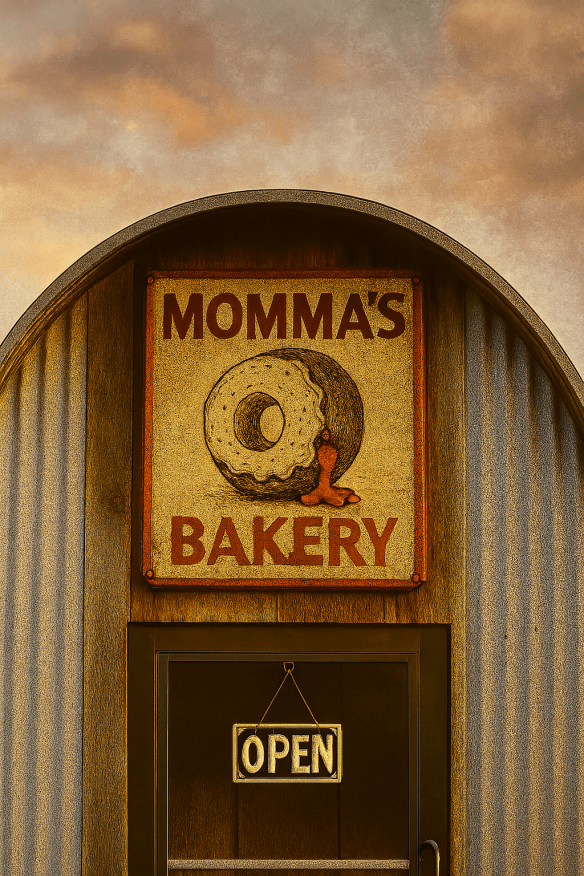
Hallie saw the sign on a bright yellow Quonset hut. It had a large donut with red jelly oozing like a waterfall, and it read Momma’s Bakery. Her stomach growled.
“I’m going to grab something to eat. Is that alright with you, Marlin?”
“It’s Martin. I don’t have any money. Are you paying?”
“Not for yours, sonny. Maybe you could wash some windshields. Or better yet, sit in the car.”
Hallie pulled into the gravel lot. She had barely parked when a reckless driver in a fancy roadster splattered her car with gravel. Hallie opened her door, just missing the man’s custom Vette. She looked back at Martin.
“Marlin, is that who I think it is?”
“Looks like that dweeb from Channel Five, Lance Strong.”
“Maybe this isn’t such a dud, Marlin. He wouldn’t be out here to see his Aunt Tillie.” She looked at Lance, who was on his cell phone and didn’t realize she was alive.
“Alright, here’s the plan. I’ll go in and make some small talk to see what kind of scoop I can get. You don’t want to seem excited in front of another reporter.”
“Makes sense, some kind of way,” Martin said. “You want me to come with?”
“No. Stay here. I’m incognito,” Hallie said, turning and heading for the bakery. Lance Strong looked up, but he didn’t seem to recognize her. Of course, he didn’t; she was nobody.
Martin Fishbein watched his mentor. She was a middle-aged woman with attractive legs and wind-tousled hair. All she needed was a matching babushka for her denim jumper. But I like her, he thought. She seems so genuine.
Glass cases lined the worn linoleum floor, showcasing a variety of colorful donuts. A red-faced man stepped out from the back room, wiping his hands on his apron.
“Help ya?” The tone of his voice showed he didn’t want to help her at all.
“Yes,” Hallie said crisply. “I’ll have a grilled bagel with a side of fat-free cream cheese, please, and a cup of hot tea.”
“Got no bagels. No tea either,” he wiped a rag across the counter, rearranging the bacteria.
“Just give me any pastry you have, baked or fried—I really don’t care. I assume you have coffee.”
“No prob,” he said, waving the rag toward her. “Aren’t you a little far from Slickerville?”
“Pardon?”
“City slickers, I can sniff ‘em out, ya know.”
“Somehow, that doesn’t surprise me. I think we got off on the wrong fried cake here, friend. I’m Hallie Ruben, a reporter for WQIP.”
“Ah-ha. I’d better get Gussie to toss another batch in the fryer. You gotta be here about the bad doings up north.”
“Yeah, they give me all the crappy jobs.” She accepted the glazed donut and a cracked mug filled with rich brew.
The baker gave her a puzzled look and moved down the counter to assist Lance Strong. Hallie chose the table by the window and took a bite of the pastry. It was heaven.
“What’s the fat content in those?” Lance examined the pastries as if calories could leap onto his waistline just by being near them.
“How should I know? I’d say they’ve got about as much fat as your wife’s backside.”
“Coffee, black—that’s it.”
He sat at the neighboring table, with his back facing her. The phone in his shirt pocket was playing some strange music.
“Lance here.” His voice sounded flat and canned. He looked smaller than on TV and a bit pale now that she got a good look at him. But smooth. Very, very smooth. “I want at least a ten-minute slot for this one, Sam,” Lance Strong barked. “And don’t screw this up. If we don’t nail this down, I will personally see to it that your aged mother dies picking remnants of your ass off the face of the moon.”
He slipped his phone into his pocket, turned, and looked at her. He looked like he was about to say something, then he was out the door before she could whistle Dixie.
“I’ll have two more glazed donuts, please,” she purred. The baker flashed a wide grin. Denture paste peeked above his bridge line, a pinkish pulp. Somehow, being single didn’t feel so bad.
“Around here, some say I’m the guy to see when you want info. Of course, I wouldn’t go spilling my guts to the likes of that one who just left.”
“I know what you mean, sir,” Hallie whispered. “That’s Lance Strong. From TV, you know?”
“Damn, I saw that fancy man from a mile away. I know his kind. I am not talking to someone like him. Now you,” he winked. “That might be a different story, if you catch my drift.”
“Ah, the dead horse. Glad you brought it up. What could be so newsworthy about a deceased horse that would grab a top news anchor’s attention across the county line?”
He looked around the room, then leaned over the glass case.
“Heard it on the scanner an hour ago. It’s not a horse–it’s a kid.”
“A goat?”
“A child. A little one. No one’s saying who it is, though. Just take the road north through town and continue on Cedar Creek Road until you reach Territorial. You’ll be looking for O’Bryan’s farm. Look for the two-track.”
“What’s a two-track?”
“A rut for each tire,” he chuckled. “Rumor has it that it’s a little girl. The cops, they stop for their complimentary, ya know, and I hear ’em. Elmo Carter was blowing off steam to another country boy. Seems a furner is nosing around like a hound dog on rabbit stink.”
“A furrier?” Hallie asked in confusion.
“You know, a furner, from some furn country.”
“Oh, a foreigner.” She smiled. It was like visiting Greece—a whole new language. She felt like she needed a Berlitz course in Backwoods English. “Now that’s very interesting!”
“Good luck to ya’.” He waved his greasy rag, and she imagined a thousand germs splattering on her unprotected face.
Martin Fishbein looked rather surly when she returned to the car. She dug through piles of old newspapers that hadn’t been read until she found the road map. She had frosting on her chin in the mirror.
“I see we had a nice, tidy little breakfast,” Martin’s voice cracked somewhere between bass and tenor.
“I’ve been working. This dead horse is really a kid. A very dead kid. This story could make my career,” she said, handing him the donuts and the road map. “Here, make yourself useful.”
“You’d better hurry. Once the word gets out, they’ll send the real crew.”
“The baker gave me directions, so we won’t need to stop at the police station. We’re going to get the drop on WCRP.”
The road hummed beneath the high-quality tires all the way to Cedar Creek.
“Look!” Martin shouted. “It’s the WQIP crew and WCRP, too.” The police station was the size of a gift shop, and a crowd of gawkers surrounded it.
“We can beat them,” she said and then stomped on the gas pedal. The rogue news crew arrived at O’Bryan’s farm fifteen minutes later. The shoulder was empty, except for one Cedar Creek patrol car. She parked next to it. The insignia was slightly crooked on the door, as if it had been put on as an afterthought. Or maybe it was one of those magnetic decals that peeled off at night and ended up being Bob’s Pizza Delivery.
Hallie opened the road map and figured out precisely where they were.
“Okay, Marlin. We’re going to walk through those woods and see how close we can get to those people over there.”
“You mean that policeman standing next to the guy on the horse out in the field?”
“No, I mean the lion tamer who’s whipping the big cats through the fire hoop at the circus.”
“I see why you’re assigned crappy stories,” Martin said as he packed up his gear. “And I know why you’re single.”
Enter your email address to receive email updates as new chapters are added. Be sure to check your email after to confirm.
CEDAR CREEK, MICHIGAN Chapter 5 A Midwest Cop Shop
Detective Hank Bradford searched through a pile of misdemeanors and the occasional felony, looking for his electric bill. Not much was happening in Cedar Creek except for the chaos in the outer office.
“And you have to PUSH the dang button to use the intercom, Sheila. It doesn’t just come on by itself,” Barney Deters shouted. He was Cedar Creek’s beloved Police Chief, so he was forgiven for being a man just a bit too old for the job.
Sheila Crane, the new part-time dispatcher, muttered a response, but Hank couldn’t hear it from his office. He was just relieved because her voice had an irritating nasal quality that seemed to drill into his brain and drain gray matter out through his ear.
“See? Like that,” Barney wheezed, pushing his thinning white hair back. The on-the-job lessons weren’t making him feel better.
“Yes, I KNOW,” Sheila wailed. “I don’t see how I can push that, and then not let the other one pop up, and then the person on the line is gone and…”
The buzzer hidden under the doormat announced a visitor. Hank knew the commotion would be delayed until some unlucky citizen’s concerns were addressed. Still, he was hesitant to go to the reception desk.
Troy Hunsacker was at the counter. Before Sheila could greet him, Esther VanderLaan burst through the door and stood right behind Troy. Hunsacker had a bag of empty beer cans.
“No even-steven trades today, Troy,” Barney admonished. “You go right back to Dell’s and get your money for those danged cans. We speak only greenback here.”
“Man, I need my car,” Troy grumbled. “I was at the bowling alley last night, and Ernie’s Towing stole it. I wanna press charges, too.”
“Just pay the tow fee, Troy. You called them,” Hank hollered from his office doorway. “Don’t you remember? You called them because you’d locked your keys inside.”
“Oh,” Troy said. He looked down at his plastic bag. “You guys don’t have any empties, do you?”
“Hold on, son,” Barney said as he entered his office. When he stepped out a minute later, he was holding a twelve-pack of Zippy Soda cans. “Here. Ernie will be glad to get your heap out of his lot.”
“Thanks, Chief,” Troy said.
Esther pushed Troy aside with her cane. When he didn’t move quickly enough, she prodded him. She wasn’t gentle. Troy obeyed and stepped back.
“BARNEY DETERS.” Mrs. VanderLaan slammed her purple plastic purse onto the countertop.
The phone rang again, and Sheila turned her attention to the switchboard, making a quick escape. Barney stood like a snow-capped mountain—nowhere to hide, with no place to run.
“Why, hello there, Esther. How’s the old rheumatism treating you?”
“Stuff it, Deters. I’m a Christian and you know it,” Esther wailed. She was as deaf as a post.
“I come to tell you there was funny goings-on at the Reverend Carrington’s house last night.” Esther snapped her purse open and grabbed a fistful of tissues. “I swear there’s more comings and goings over there than a common bawdy house.”
“Now, Esther. You know the Reverend keeps a respectable home.” Barney edged toward his office. First chance he got, he’d make a run for it.
“My dog, Sunday, woke me up at the crack of dawn, sniffing and whining. I let her outside, and who do I see pedaling down the street on his bike?” Ester pounded on the counter for maximum effect.
Barney knew she was talking about the town’s most mentally challenged citizen, Fly Carrington. Who just happened to be the helpless child of the widower, Reverend Carrington. He played dumb. He wanted to say, “Hi, Fly.” But he held his tongue.
“Reverend Carrington riding a bicycle?”
“Not the preacher, you old windbag. Get the wool out of your ears.” Esther was shouting, and this wouldn’t seem so strange if she had teeth. As it was, she was barely intelligible with her lips flapping like window shades. Hank peeked out of the office, worried that Esther’s head might start spinning and fly clean off.
“Hey, Mrs. VanderLaan,” Hank said.
“I’m not paying for you to mow my lawn, sonny,” she shot back. “And then, after Fly Carrington came up the road, Mike O’Bryan pulled out of the driveway next to the church cemetery. Now I ask you, what are those two up to in the darn middle of the night?”
“Maybe it was a conspiracy,” Hank said, grinning. He was surprised she didn’t vault over the counter and bash his brains in with her cane.
“I was watching that Carrington boy, Barney Deters. Neat as you please, the little piss-ant opened the basement window and slipped down smoothly. You mark my words; he’s probably out raping and pillaging.” Esther patted her brow with the wad of tissues. “A person’s not safe in their own home ‘round here. Lord knows what that drunk, O’Bryan, was up to.”
“You know Fly’s harmless, Esther. He wouldn’t hurt anyone,” Barney reassured her. “And Mike may tip a few, but he’s got no record.”
“Well, I never. I said nothing at all about your fly, Barney Deters.” She grabbed her purse and slammed the door so hard that it made the calendar on the wall shift askew.
“Looney tunes old broad,” someone whispered.
“Uh, can I cut in here for a minute?” Sheila asked. Her headset hung crooked. Hank grabbed a cup of coffee from the ancient coffee maker.
“Steve’s on the phone.” Brooks was a rookie and the only road officer employed by the City of Cedar Creek.
“And? Well, what? Are you going to tell me, or is this a game of twenty questions?” Barney snarled slightly.
Hank interrupted. “What does Steve need, Sheila?”
“He’s at the O’Bryan place. It’s about that horsetail sticking out of the ground. Turns out there’s a dead body out there.”
“Great Grandma’s panties, can’t they tell the difference between a horse and a person?” Barney barked.
“Well, why don’t you just ask him yourself?” Sheila wished she were back at Thunderdog Lanes, handing out rented bowling shoes that reeked of foot gas.
Barney pressed the speaker button, and Hank came over to listen in.
“Yeah, Steve. Go ahead and tell us.”
“Sir, it’s a little redheaded girl. She’s buried up to the topknot,” Steve coughed nervously. “Sir, what should I do? Over.”
“Hold the fort, Brooks. Don’t let the civvies touch anything. Hank and I will be right out. And quit saying ‘over’. It makes you sound like some rookie jerk.” Barney looked at Hank, who was examining flotsam in his coffee.
“Some evil SOBs got to pull off a big city crime and dump it out here in the wilderness, like we don’t have enough problems,” Barney fished for his keys.
Hank’s mood was downcast.
“This is going to be terrible for the folks around here. We’d better get out there in a darn hurry and act like we know what we’re doing,” Hank said, itching for a cigarette. “We don’t have any missing kids around here, so it must be a kid from another county.”
“Or state. Like I said, if some maniac is dumping victims in our jurisdiction, it makes us look bad. God Almighty, a kid—that’s beyond evil. What’s this world coming to?”
“It’s Armageddon, Barn. Look, they have us surrounded like the Alamo,” Hank said as he stared out the front window. “It’s the scanner crowd. You’d think people would have better things to do than gather around those annoying squelching machines, waiting for the next human tragedy to be announced.”
“At least the press isn’t aware of it yet.” Barney grabbed a few items, including a couple of rolls of crime scene tape. “Hank?”
“Yeah, boss,” he replied.
“Don’t you think it’s kind of strange that O’Bryan was out late last night and a body was found on his farm?”
“I guess it is, Barney. But Fly Carrington bikes out that way all the time. He was out last night as well. Meet you in the car.”
Hank looked around his office and spotted his shotgun propped in the corner with a plastic grocery bag hanging from its sight. He grabbed the weapon, slipped a pack of hidden cigarettes from the drawer, and headed for the cruiser. He ignored the shouts from the scanner buzzards and looky-loos.
“Let’s go!” Hank muttered, slamming the door of the car.
Barney jerked the wheel quickly away from the curb and accelerated.
“Son of a bitch, Deters. You drive like an old man with a hat.”
Barney looked at his friend and grinned. He winked at Hank before letting out a deadly fart.
“Hear the horn?” Barney’s eyes twinkled. “It’s Gabriel calling your name!”
Enter your email address to receive email updates as new chapters are added. Be sure to check your email after to confirm
Detective Hank Bradford searched through a pile of misdemeanors and the occasional felony, looking for his electric bill. Not much was happening in Cedar Creek except for the chaos in the outer office.
“And you have to PUSH the dang button to use the intercom, Sheila. It doesn’t just come on by itself,” Barney Deters shouted. He was Cedar Creek’s beloved Police Chief, so he was forgiven for being a man just a bit too old for the job.
Sheila Crane, the new part-time dispatcher, muttered a response, but Hank couldn’t hear it from his office. He was just relieved because her voice had an irritating nasal quality that seemed to drill into his brain and drain gray matter out through his ear.
“See? Like that,” Barney wheezed, pushing his thinning white hair back. The on-the-job lessons weren’t making him feel better.
“Yes, I KNOW,” Sheila wailed. “I don’t see how I can push that, and then not let the other one pop up, and then the person on the line is gone and…”
The buzzer hidden under the doormat announced a visitor. Hank knew the commotion would be delayed until some unlucky citizen’s concerns were addressed. Still, he was hesitant to go to the reception desk.
Troy Hunsacker was at the counter. Before Sheila could greet him, Esther VanderLaan burst through the door and stood right behind Troy. Hunsacker had a bag of empty beer cans.
“No even-steven trades today, Troy,” Barney admonished. “You go right back to Dell’s and get your money for those danged cans. We speak only greenback here.”
“Man, I need my car,” Troy grumbled. “I was at the bowling alley last night, and Ernie’s Towing stole it. I wanna press charges, too.”
“Just pay the tow fee, Troy. You called them,” Hank hollered from his office doorway. “Don’t you remember? You called them because you’d locked your keys inside.”
“Oh,” Troy said. He looked down at his plastic bag. “You guys don’t have any empties, do you?”
“Hold on, son,” Barney said as he entered his office. When he stepped out a minute later, he was holding a twelve-pack of Zippy Soda cans. “Here. Ernie will be glad to get your heap out of his lot.”
“Thanks, Chief,” Troy said.
Esther pushed Troy aside with her cane. When he didn’t move quickly enough, she prodded him. She wasn’t gentle. Troy obeyed and stepped back.
“BARNEY DETERS.” Mrs. VanderLaan slammed her purple plastic purse onto the countertop.
The phone rang again, and Sheila turned her attention to the switchboard, making a quick escape. Barney stood like a snow-capped mountain—nowhere to hide, with no place to run.
“Why, hello there, Esther. How’s the old rheumatism treating you?”
“Stuff it, Deters. I’m a Christian and you know it,” Esther wailed. She was as deaf as a post.
“I come to tell you there was funny goings-on at the Reverend Carrington’s house last night.” Esther snapped her purse open and grabbed a fistful of tissues. “I swear there’s more comings and goings over there than a common bawdy house.”
“Now, Esther. You know the Reverend keeps a respectable home.” Barney edged toward his office. First chance he got, he’d make a run for it.
“My dog, Sunday, woke me up at the crack of dawn, sniffing and whining. I let her outside, and who do I see pedaling down the street on his bike?” Ester pounded on the counter for maximum effect.
Barney knew she was talking about the town’s most mentally challenged citizen, Fly Carrington. Who just happened to be the helpless child of the widower, Reverend Carrington. He played dumb. He wanted to say, “Hi, Fly.” But he held his tongue.
“Reverend Carrington riding a bicycle?”
“Not the preacher, you old windbag. Get the wool out of your ears.” Esther was shouting, and this wouldn’t seem so strange if she had teeth. As it was, she was barely intelligible with her lips flapping like window shades. Hank peeked out of the office, worried that Esther’s head might start spinning and fly clean off.
“Hey, Mrs. VanderLaan,” Hank said.
“I’m not paying for you to mow my lawn, sonny,” she shot back. “And then, after Fly Carrington came up the road, Mike O’Bryan pulled out of the driveway next to the church cemetery. Now I ask you, what are those two up to in the darn middle of the night?”
“Maybe it was a conspiracy,” Hank said, grinning. He was surprised she didn’t vault over the counter and bash his brains in with her cane.
“I was watching that Carrington boy, Barney Deters. Neat as you please, the little piss-ant opened the basement window and slipped down smoothly. You mark my words; he’s probably out raping and pillaging.” Esther patted her brow with the wad of tissues. “A person’s not safe in their own home ‘round here. Lord knows what that drunk, O’Bryan, was up to.”
“You know Fly’s harmless, Esther. He wouldn’t hurt anyone,” Barney reassured her. “And Mike may tip a few, but he’s got no record.”
“Well, I never. I said nothing at all about your fly, Barney Deters.” She grabbed her purse and slammed the door so hard that it made the calendar on the wall shift askew.
“Looney tunes old broad,” someone whispered.
“Uh, can I cut in here for a minute?” Sheila asked. Her headset hung crooked. Hank grabbed a cup of coffee from the ancient coffee maker.
“Steve’s on the phone.” Brooks was a rookie and the only road officer employed by the City of Cedar Creek.
“And? Well, what? Are you going to tell me, or is this a game of twenty questions?” Barney snarled slightly.
Hank interrupted. “What does Steve need, Sheila?”
“He’s at the O’Bryan place. It’s about that horsetail sticking out of the ground. Turns out there’s a dead body out there.”
“Great Grandma’s panties, can’t they tell the difference between a horse and a person?” Barney barked.
“Well, why don’t you just ask him yourself?” Sheila wished she were back at Thunderdog Lanes, handing out rented bowling shoes that reeked of foot gas.
Barney pressed the speaker button, and Hank came over to listen in.
“Yeah, Steve. Go ahead and tell us.”
“Sir, it’s a little redheaded girl. She’s buried up to the topknot,” Steve coughed nervously. “Sir, what should I do? Over.”
“Hold the fort, Brooks. Don’t let the civvies touch anything. Hank and I will be right out. And quit saying ‘over’. It makes you sound like some rookie jerk.” Barney looked at Hank, who was examining flotsam in his coffee.
“Some evil SOBs got to pull off a big city crime and dump it out here in the wilderness, like we don’t have enough problems,” Barney fished for his keys.
Hank’s mood was downcast.
“This is going to be terrible for the folks around here. We’d better get out there in a darn hurry and act like we know what we’re doing,” Hank said, itching for a cigarette. “We don’t have any missing kids around here, so it must be a kid from another county.”
“Or state. Like I said, if some maniac is dumping victims in our jurisdiction, it makes us look bad. God Almighty, a kid—that’s beyond evil. What’s this world coming to?”
“It’s Armageddon, Barn. Look, they have us surrounded like the Alamo,” Hank said as he stared out the front window. “It’s the scanner crowd. You’d think people would have better things to do than gather around those annoying squelching machines, waiting for the next human tragedy to be announced.”
“At least the press isn’t aware of it yet.” Barney grabbed a few items, including a couple of rolls of crime scene tape. “Hank?”
“Yeah, boss,” he replied.
“Don’t you think it’s kind of strange that O’Bryan was out late last night and a body was found on his farm?”
“I guess it is, Barney. But Fly Carrington bikes out that way all the time. He was out last night as well. Meet you in the car.”
Hank looked around his office and spotted his shotgun propped in the corner with a plastic grocery bag hanging from its sight. He grabbed the weapon, slipped a pack of hidden cigarettes from the drawer, and headed for the cruiser. He ignored the shouts from the scanner buzzards and looky-loos.
“Let’s go!” Hank muttered, slamming the door of the car.
Barney jerked the wheel quickly away from the curb and accelerated.
“Son of a bitch, Deters. You drive like an old man with a hat.”
Barney looked at his friend and grinned. He winked at Hank before letting out a deadly fart.
“Hear the horn?” Barney’s eyes twinkled. “It’s Gabriel calling your name!”
Enter your email address to receive email updates as new chapters are added. Be sure to check your email after to confirm.
The Omega Consensus was supposed to be a source of hope, a blueprint for a better tomorrow. Instead, it became a weapon—twisted, silent, and deadly. Blackmail runs through its veins. Greed drives its pulse. No one knows how long it’s been compromised. No one’s talking. Oil prices spike. Fingers point. And in the shadows, Al Amorta Ujung waits—an extortionist syndicate with its sights set on the throat of the United States. They don’t want money. They want control. And they’re willing to burn the world to get it.
Available in print, but also serialized online to read absolutely free. Chapters drop twice each week on Mondays and Thursdays. Subscribe to receive email updates.
Here is chapter one of our serialized novel. If you missed the prologue, you can find the link for it on the table of contents page.
CEDAR CREEK, MICHIGAN Chapter 1 BAD SMELLS AND FAIRY TALES
“Willson Estate.” Digby’s deep baritone startled Richard Underhill.
“I want to speak to Senator Willson. Now!”
“The Senator is indisposed, sir.” Digby Brown felt his butler’s job was an endless series of never-ending tasks that involved nothing but dumbbells and nincompoops.
“Would you like to leave a message?”
“No matter where he is, or what he’s doing, you tell that old sack that Richard Underhill wants to have a chat.” Underhill’s voice was annoyingly whiny.
“Are you a constituent, sir? Because I can give you his Senate Office number.” Digby then started the list he’d repeated nearly every day to upset Virginians wanting to complain about a government screw-up.
“Listen, Jeeves, and listen carefully. You tell Mr. High and Mighty that Richard Underhill has a situation.” Richard looked down at Sarah. The dead child was curled up on his bed. “You tell him to take this call if he wants to keep that fancy-ass title of his.”
“Can you hold, sir?” Digby had already pressed the record button to start the machine, just in case the FBI needed to hear this. “I’ll see what I can do.”
“Yeah, Jeeves. Do that. Go ahead and fetch that old SOB,” Underhill settled onto the pillows next to the dead child. “I’ll wait right here.”
Digby poked his head into the library. The Senator was deep in conversation with Senator Armitage.
“Sir, I hate to bother you, but there’s a fellow named Richard Underhill on the phone, and he seems eager to speak with you.”
“Blast!” Senator Willson jumped out of his chair like a jack-in-the-box and ran across the room. Percy Armitage looked angry; he didn’t like to take a back seat to anyone.
“I take it you want to talk to this Underhill person?” Digby whispered.
“Yes, damn it,” Willson growled, then turned back to his colleague.
“Excuse me, Percy. This could be very important.” As he hurried down the hall, the Senator snarled, “Digby, get Percy a scotch.”
When Willson reached for the phone, he hesitated. He knew whatever it was Underhill wanted could be a potential political land mine. He pressed the receiver to his ear.
“This better be good. You are one sick, bloodsucking bastard,” Willson hissed.
“Well, well. It appears that some tension is present. I have a bit of a dilemma, Senator.”
“What’s that? Spit it out, Underhill.”
“That’s not a nice way to talk to your favorite blackmailer, Senator,” Richard said in a somber voice. “It’s a good thing I don’t hold grudges. It’s about the kid you got for me. Just like Humpty Dumpty, the stupid little girl broke into a million pieces. I don’t suppose you can get me another.”
“You are a perverted little runt,” Willson hissed. “I’m not getting another innocent child for you to torture. My God, what have I done?”
“There’s no need to get personal, Senator. I think you’ve forgotten who you’re dealing with.”
“You creep. I know exactly who you are: a short, balding pervert who can’t get over being called freak face in elementary school. Do you think it’s fair retribution to ruin a child’s life? Now you’re a murderer.”
“I swear I didn’t murder her. Shit, I’m a lot of things — evil things — but not that.”
“You have no idea who you’re dealing with, Underhill. We’re both involved with some dangerous people, and we’re in serious trouble.”
“Willie, it was just an unfortunate accident. Someone’s got to get this dead kid out of my house—a little clean-up operation, if you don’t mind.”
“Don’t call me Willie—ever. I know you have an emergency card for that child. It tells you exactly what to do if she gets sick or dies. Find that card in the crawl space where you live and follow the instructions. I’m done dealing with you.”
“Do you want everyone to know about the Sunshine Boys Resort? Like, say, your constituents?”
“Don’t threaten me. I have people who can make you disappear.” Willson slammed the phone down and slid a nitroglycerin tablet under his tongue.
The pain in his chest had been worsening lately. It took two tablets before he could join Senator Armitage to discuss strip-mining in Appalachia.
On the other end of the line, in rural Southeastern Michigan, Richard Underhill sat holding the dead receiver.
“Crap on a cat,” he muttered. “Where the hell is Emily when you need her? Oh yeah. The bitch left.”
His wife wasn’t coming back, that was obvious. It was hard to believe she found such courage somewhere, packed up her two boys, and left.
This is entirely her fault. None of this would have happened if Emily had been here. She’s like that emergency brake the train engineer pulls. Without her, I have no control over my accelerator. How’s a guy supposed to curb his primal urges without some whiny bitch to hold him back? This is her fault.
He went to the closet and searched through the shoes until he found the lockbox hidden beneath the floorboards. The box was heavy, filled with evidence of his past sins. He opened it carefully, as if some of them might escape.
If it’s not here, it’s in the basement. Those sons of bitches gave me papers for this kid. But where did I put that damn emergency card?
Hearing a noise, he looked back at the bed. The lifeless body still lay there; her eyes rolled back in her head like a creepy baby doll. He walked over and prodded her. She didn’t flinch.
You wouldn’t think they’d be so damn fragile. I finally got rid of the wife and have a little free time, but the kid takes a nap on me. Just dandy. Maybe I should snatch that friend of hers. Maggie’s a cute little thing — but I think her mom is onto me. Better not. Right now, I’ve got to get rid of this body or it’s going to stink like an outhouse in here.
He went back to his box, digging through the papers with his dirty, tobacco-stained fingers. He retrieved the card he had hidden recently and sat on the bed’s edge beside Sarah. He gazed at her peaceful face, noticing a faint smile that irritated him.
“Not much to laugh about now, huh?” he said, giving her a quick nudge in the ribs. Hooha, a stuffed bear, escaped her grip and hit the floor, leaving behind its signature glob of fluffy white batting.
Richard grabbed the phone and dialed the long-distance number on the card. As it rang, he drummed his fingers on the nightstand.
“Hello?” Jah Lo’s voice was that of an angry Asian male.
“What the?” Underhill said. “Where the hell am I calling? You sound like you’re in China.”
“Who is this?”
“Richard Underhill.”
“I don’t like your language, Mr. Underhill,” Jah Lo snapped.
Richard shot back, “I don’t like your accent.”
“You are calling about what number?”
“Number? I don’t know.”
“On the neck tag, I require the ID number.”
“Oh, sorry.” He awkwardly held the dead child in a strange dance, shifting her until he found the medallion. “It’s E20028. I believe you called her Azara, but I refer to her as Sarah. Is that what you want?”
“Mr. Underhill, from Michigan. That’s in the States, isn’t it?”
“Yes, of course. Who are you?”
“Al Amorta, Mr. Underhill,” Jah Lo said. “What brings you calling?”
“Well, Al, it looks like I have a dead kid on my hands.”
“That’s too bad for you. We’re happy to help, but you need to follow our instructions exactly if you want to see the sunrise.”
“You can’t talk to me like that. I’m a friend of Senator Willson’s.”
“We can talk to you however we want. You see, my American friend, you have unfortunately reached the headquarters of the Al Amorta Ujung. Please don’t move. I will call Sanctuary and send a unit to retrieve the clone’s body. I’d suggest you not to defy us.” He clicked off.
Richard Underhill waited beside Sarah for a long time until he heard the crunch of gravel in the driveway. He was scared, and Dicky Freak Face didn’t like feeling afraid. Not one bit.
Enter your email address to subscribe, then check for our confirmation email in return. Keep up to date on every post in this series.



 Monty & McCluskey