
No Tour Guides in Hell: Chapter 7

CEDAR CREEK, MICHIGAN: THE BODY

“Hey, what’s up, Hank?” Barney Deters had one of his bad feelings. “You’ve been smoking like a house afire. Everything okay?”

“Sure,” Hank replied. But Barney could tell it wasn’t true. Whenever Hank went silent, trouble soon followed.

“You look like someone took a dump on your petunias,” Barney eyed his friend. The worried expression was troubling. “You miss Blanche? She’d be sore at you.”

“Christ, Barney. You can’t have the love of your life gradually fade away and then suddenly act all cheerful like Happy the Clown.”

“That was over five years ago,” Barney said. “I think you can stop wearing black now.”

“It’s my Johnny Cash look, ok?” Hank said. “Five years? Has it really been that long?”

“Every day of it,” Barney said. “I loved her, too. We all loved her. She made one hell of a lemon pie.”

“Change the subject, Barn. I don’t want to talk about this.”

“Okay, let’s discuss dead kids,” Barney said.

“Mark my words, every dip-wad reporter this side of Lansing will be out here before supper.” Hank stared out the window. Barney wondered if Hank was tearing up.

“I hope Steve had enough sense to secure the scene. He doesn’t have much experience.”

“He’ll be okay. He was at the top of his class at the Academy.”

“I meant to talk to you about that,” Barney said. “I checked his references, and he didn’t attend the one he listed. I’m going to pursue that bit of information.”

“I saw his certificate,” Hank frowned. “He even has a picture with his graduating class stuck inside his locker.”

“Oh, good. I was getting a hinky feeling about the whole deal.” Barney plucked his grandpa’s silver shoehorn from his shirt pocket and waved it at Hank. “We’re going to need tools, so I brought this.”

“Do you even have a procedural manual?”

“Shoehorns are handy, my friend. You can dig with them or even eat a bowl of chili when you’re in a pinch. Come to think of it, you can even scratch your backside with one. Like I was saying, Steve claims it’s a child. I was hoping for a tiny adult or a leprechaun.”

“That is an insane notion, Barney. What have you been putting in your coffee?”

“Well, shit. Whiskey. Make it anything but a child. It is just a nightmare. A dadgum hellish thing. My heart hurts, Hank.”

“To be precise, he said it was a head. Who’s to say the rest of the body is even there?”

“That’s gruesome, even for you.”

“I’m hoping the rest is buried. Bad enough as it is without imagining a damned baby head rolling around the countryside,” Hank muttered. The parade of farms flashed by. He knew every person by name. “Did Mike plow it up with a cache of turnips?”

“Nope. Amelia said little Maggie found it. She went out to burn the trash,” Barney wheezed. “Then she came running back to the house like she’d seen the Devil himself.”

“Poor kid.”

“It’s a goddamn shame. Had a dirty ribbon she’d pulled straight out of the dirt. The tassel of hair came right up out of the soil. Poor kid thought it was a horse’s tail.” Barney screwed up his face like he did when something gnawed at his guts. “Mike said he just couldn’t bring himself to believe it was a person, and it did kind of look like a horse’s tail.”

“Nothing unusual about livestock turning up dead around here.”

“Well, it might seem a little strange if it wasn’t your livestock.”

“True,” Hank inhaled and let the nicotine soothe him. “Very true. And we still must consider what Esther VanderLaan said earlier today. What was Mike doing at the cemetery last night?”

“What was Fly doing riding his bike at the crack of dawn?” Barney countered.

Taking a right, they drove down the rutted driveway that runs along the western edge of O’Bryan’s property.

“I don’t relish having a case of mysterious cadaver on our hands,” Hank admitted. “Brings the nuts out of the woodwork, psychics and shit.”

“Every crackpot’s going to be hunkered in our lobby. Not to mention the psychos who want to have a look-see.” Barney spotted something on the side of the road; an opossum’s remains lay in a death curl. “I love roadkill. That’s the only kind of cadaver I want in my jurisdiction.”

Barney carefully drove the patrol car through patches of turned soil, scraping the muffler on fallen branches. The rear wheel skidded on the loose dirt before slipping into a crevasse and getting stuck. He stepped out to check the buried hub, while Hank sniffed the air.

“Smells like you parked on some good old American cow shit to me.” Hank grabbed his equipment and made his way to safe ground. “You’ll notice that Steve had the good sense to stay on the road. This could work out, though. Wait till you get a gaggle of news hounds and then floor the son-of-a-bitch.”

Barney was not laughing when the state police car pulled in, tried to go around them, and got stuck on another mound of dung. Sergeant Elmo Carter stepped out, none the happier.

“What’s the matter, Carter? Are you stuck?” Barney grinned.

Elmo muttered a few curses.

“You seem like a man with a hot foot, Elmo. The body isn’t going to get any deader!”

Elmo tripped over a rock, picked it up, and heaved it into the ditch. He stood at least six-four, dwarfing his colleagues. A menacing frown replaced his usual pleasant nature.

“Tread lightly, Deters,” Elmo Carter said. “I’m in a terrible mood today.”

“Who called the State Boys?” Barney shouted as his foot sank into the dark loam. “Aw, shit. Who called you?”

“Don’t know.” Carter quickened his pace.

Hank followed them, wondering if he might have to be a witness when they fought each other. Then he noticed people standing at the tree line, watching. He wandered over.

“Can I help you?” he asked because the woman was nearly beautiful and clearly out of her element.

“I’m Hallie Ruben, from WQIP,” Louey said. “This is Marlin Fishbrain.”

“Martin Fishbein,” the youth corrected. “I’m an intern.”

“I’ll just bet you are,” Hank said. “Listen, we need to preserve this scene. Could you go back to the road, Miss?”

Hallie felt like a schoolgirl. She thought he had nice eyes. He turned and walked away. Then he looked back at her for no good reason.

She grabbed Martin’s arm and guided him toward the road.

“Come on, Marlin,” she said. “Do what the man says.”

“Are we getting in on this or what?” Martin asked, earning himself an extra twist that almost took his forearm off his elbow.

“You need to learn to play nice, Martin,” Hallie hissed. “If they take a dislike to you, you’re shut down in no time.”

Mike O’Bryan sat atop his horse, talking with Brooks. The clearing was an oasis from the scrub of the fallow field, with loosely turned dirt and deadfall piled in the middle.

There was a burn barrel, or at least part of one. One side had collapsed, spilling incinerated trash debris from its yawning, rusty top. The area was marked with bright yellow crime scene tape.

Even a novice detective could identify the tracks: horse’s hoof prints and a small child’s bare feet. Along the eastern edge of the circle, there were indistinct prints of a man’s right shoe and a bare left foot. Branches had been dragged across the area, but the prints remained clearly visible in the soft dirt.

“Who cordoned this scene?” Carter asked, interrupting Steve’s first real police interrogation.

“I did,” Steve shot back. “Who’s working on this anyway? I thought it was ours.”

Barney joined the debate, still panting from the chase.

“It’s within the city limits, Elmo. We incorporated Wisteria Township last year. This is our turf.” He bent over, gasping for breath.

“Damn it, Deters.” Carter kicked at the loose dirt. “I’m just following orders.”

“That’s way more interesting, Elmo—since O’Bryan only called us about twenty minutes ago. You guys are more than an hour away.” Barney looked at the officer suspiciously. “How did you know there was a body here if Maggie hadn’t found it yet?”

“Why don’t you call one of those Psychic Hotlines and ask them?”

Hank looked at Barney, whose face was turning redder by the minute. The old man was about to lose his temper.

“You involved in this, Elmo? This doesn’t even make sense. You had to get a call before the body was found. What aren’t you telling us?”

“I don’t like your tone,” Elmo snarled. He got the call while he was at a meeting in Lansing. That was at seven this morning. His report would say it was anonymous, but it had come from the governor’s office. His instructions were clear: go to O’Bryan’s place, find a body in the clearing, and make sure a man from the state crime lab has access.

“That’s shady, Elmo,” Barney shot him a dirty look.

“You questioning my integrity? I think you know me better than that, Deters.” Elmo’s voice was menacing as he towered over the Chief.

“Uh, excuse me, fellas. Can I go home now?” Mike’s horse was uneasy. It pawed at the loose dirt. “This guy is ready for fresh hay.”

Getting no response, O’Bryan lifted the reins and headed back to the barn.

“Stay at the house, Mike,” Hank called after him. “One of us will be over later.”

Barney watched Mike’s face. He seemed nervous, maybe more than someone who just stumbled upon a dead body in his field should be. This whole situation was going to get uglier before it got better.

“Okay, you two prima donnas, let’s get to work.” Hank, always the peacemaker, clapped both Elmo and Barney on the back, breaking the tension. “You’ve been friends for a long spell. Let’s dig up this poor kid, and you two can fight over who owns the case later.”

Steve had covered the gruesome scene with a blanket. As he moved it away, Barney took his first deep breath in years. Hank was caught off guard by a swarm of bees that was suddenly released into his head. Then, the dizziness passed.

A shock of coarse red hair was tangled next to the child’s head. Her eyelids were slightly parted, and dirt particles dotted the whites of her cloudy green eyes. She stared at the sun, unblinking.

The men shared a quick glance. Hank shrugged and took off his shirt. The hot sun warmed the cold sweat he’d broken into. He tied his red bandana around his head to keep the flow of sweat down. Then he grabbed a shovel and carefully started digging around the head where Steve had left off.

Working silently, he loosened the soil while Barney and Elmo scooped it carefully away from the body. She had died too recently for decomposition to distort her peaceful face. They bagged the soil to sift through later.

After what seemed like forever, a little girl’s bare body lay exposed, her long burgundy hair spread around her like a shroud. Black soil clung to her skin, making her appear even paler than she had in life.

Steve took pictures with the thirty-five-millimeter camera. By late afternoon, news reporters from Detroit lined the shoulder of North Territorial Road.

Hank lit a cigarette. His hands were covered in dirt; streaks of tears ran down his tired face. Barney stood silently, thinking that the world was definitely a dangerous and ugly place.

Alec Golden, the medical examiner for Washtenaw County, arrived just after four o’clock. He was seventy-two and had long since retired from family practice in Ann Arbor. Doc was a sharp man. Although he might have lacked sophistication, he made up for it with common sense. Using his clear-headed analytical skills, he had corrected more than a few police officers’ missed observations.

He began examining the body by stabbing the lifeless child in the liver with a thermometer to check her core temperature, as was protocol for this type of scene.

“I’d say she died about 24 hours ago, give or take a little,” Doc stated.

Then a commotion erupted at the edge of the clearing. Elmo Carter was approached by a short, dark-haired man in a white lab coat. Elmo nodded and then led him directly to the makeshift morgue on a tarp.

Doc Golden eyed the swarthy fellow; he had never seen him before.

“This is Dr. Firdaus from the State Crime Lab,” Elmo explained. Golden didn’t know where it came from, but a seed of doubt planted itself somewhere in his frontal lobe. He may be a detective, but the whole thing reeked like a day-old trout to him.

“Please, if I may introduce myself, I am Syringh Firdaus.” The swarthy man breathed into Dr. Golden’s ear, a cloud of pungent curry following him like an aura of stinkweed. “I have been ordered to obtain some samples.”

“Alec Golden, at your service.” Dr. Golden rose to his feet and offered his hand. “Be my guest.”

The stranger’s grip was weak. Golden cringed. He firmly believed that handshakes reveal everything. Doc stomped off to join Barney and Hank, who crouched a few feet away, examining the contents of the burn barrel on a yellow tarp.

The lab technician worked on the body openly, showing no attempt to hide what he was doing. He lifted the right arm and made a small cut with a scalpel. Doc happened to see this act of desecration.

“Hey, what do you think you’re doing?” Doc hollered. “You can’t do that!”

“Oh, sir, I am running a test on the body to see what substances might have been ingested before death. I need a small tissue sample for this purpose,” the diminutive brown fellow deferentially replied.

“Who do you think you’re talking to? That makes no sense at all. And how am I supposed to know if there’s any wound on the child’s skin if you go and tamper with it?” Alec was irritated. “Do I look like I just clocked out of a 7-Eleven?”

“I certainly did not disturb any area showing a sign of injury. It is a tiny nick, as you see, which I have made in the skin.” The man’s ethnicity was difficult to determine by his color or accent, but his pungent perfume made Alec think of Bombay.

“It looks damn strange, and I don’t like it at all. In fact, I’m going to call your office and talk to your supervisor, Dr. Firdaus.”

“You are welcome to do this, sir,” he said, picking up his things and retreating. “I am quite finished, you know. Thanks to you all, sirs. I wish you a good day.”

“This is fixing to go down in history as a Twilight Zone moment,” Hank said. “We’d better be sure to get that down for the record.” He shook his head and glanced at old Doc Golden.

“Doc, what’s your impression of the girl? Any ideas?”

“Well, son, I’d estimate she’s about five years old. She shows no external signs of abuse, except for the slash our little foreign friend made in her armpit. Her hair is red, and redheads usually have fewer hairs than other types, but I’d say this child’s hair is sparser than usual. It might indicate some malnutrition.”

“Hmmm,” Barney mused. “So, we’ve got ourselves stuck with an abandoned kid and an unknown cause.” He looked around and bellowed, “Can we put that blanket over her?”

“Don’t know why not,” Hank grumbled. “Steve got evidence all over the poor soul anyway.”

“How long do you think she’s been in there?” Barney nodded at the shallow grave.

“Hard to say. Like I said, she died about 24 hours ago. That doesn’t mean she landed in O’Bryan’s field then, though.” Doc Golden sat down on a log beside the pile of sorted rubbish waiting to be bagged and labeled. “It’s a damn funny place to leave a body, buried so shallow.”

Grabbing a piece of cloth with his tweezers, Barney dropped it into the evidence bag.

“The perp was in a rush,” Barney noted. “Too many mistakes.”

“Maybe he chose this spot because the ground’s soft. It’d be easy to dig a shallow grave. One person could do it,” Hank pondered this.

“He buried her here because he had to,” Steve said. “Maybe he was interrupted. Maybe his car had a breakdown nearby. He left lots of tracks. He was alone, in a hurry, and this wasn’t his original destination.”

“Barn, I think the young guy has got a good head on his shoulders.”

“He’s not just a pretty face, like me,” Barney agreed.

Humor couldn’t soften the tragedy beneath the shroud. The men stood over their lifeless charge.

“I’ve got to get my car out of that damn hill I’m stuck on,” Carter turned to leave.

“Elmo, I have some questions regarding this phone call issue.”

The state officer snarled and continued walking.

“Oh, and while you’re at it, have someone call me from the Crime Lab. I want a clear explanation for the procedure your technician performed on my deceased.”

Hank and Barney made their way back to the road. The air was heavy with mosquitoes. Cows lowed in the distance. It was nearly milking time. As the men stepped out of the field, reporters pushed forward, waving their microphone booms and trying to capture the perfect sound bite for the five o’clock news.

Hank wandered off, heading toward the nearly beautiful reporter in a casual denim jumper.

“Your name again? Hallie, you said.” He plastered a charming smile on his face.

Barney watched as Hank seemed to come alive, and it was clear the lady was interested. She might just be trying to get a story, but Hank wasn’t dumb.

Barney watched the crowd. Reporters pushed and yelled to get his attention. In front, he saw Jennifer Chambers, and beside her, Lance Strong. The big guns were there.

He looked back at Hank. He had put his shirt back on, but the bandana gave him a rakish pirate look. He was lost in some animated conversation. I think this could be promising. It will kill two birds with one stone.

Barney cleared his throat and moved toward the microphones.

“This is a tragic day for Cedar Creek. We have a little girl about five years old, according to Doc Golden. Cause of death is unknown.”

“Who is it?”

“Do you know of anybody who’s missing?”

“Any suspects?”

“I’m going to make this easier,” Barney said. He pointed at the woman standing next to Hank. She looked surprised. “You, there. You’re going to be our press pool representative. All the rest of you—get out of here. Any information we have will come through that young lady.”

Hallie Ruben stared in disbelief, as did Lance and Jennifer. Hallie’s euphoric feeling was short-lived. Moments later, Hank Bradford wheeled a gurney to the medical examiner’s van. Nearly lost on the cold morgue stretcher was a tiny black body bag. It wasn’t just a story; it was a dead little girl.

This can only mean one thing, Hallie thought. It’s heartbreaking for everyone she’s touched in her short life.
……………………………………………………………………………………………………….

Enter your email address to receive email updates as new chapters are added. Be sure to check your email after to confirm.

Order Omega Consensus

Book 1 of Omega Consensus, No Tour Guides in Hell, is now available to order in print and in a Kindle edition.

For anyone without the patience to read one chapter at a time on our website, just click the cover image, and we’ll transport you to Amazon land.


The Great Fall split the country like a busted jaw. East went clean—tight suits, clipped orders, everything in its place. West went feral. No mail. No government. No taxes. Just dust, desperation, and the kind of silence that gets you killed. A militia’s forming—ragged men with rusted shotguns and twitchy eyes. They march like they mean it, waiting for the East to blink. Then Jake Barnes shows up, all questions and shadows. George “Lefty” Ho watches him from behind the bar and feels it in his gut: something’s coming. And it’s not wearing a badge.


The Omega Consensus was supposed to be hope. A blueprint for a better tomorrow. Instead, it became a weapon—twisted, silent, and deadly. Blackmail runs through its veins. Greed drives its pulse. No one knows how long it’s been compromised. No one’s talking. Oil prices spike. Fingers point. And in the shadows, Al Amorta Ujung waits—an extortionist syndicate with its sights set on the throat of the United States. They don’t want money. They want control. And they’re willing to burn the world to get it.

No Tour Guides in Hell: Chapter 6,

Detroit Michigan
Chapter 6
Hallie

Hallie Ruben was furious. No one needed to tell her she was at the bottom of the totem pole when she got the dead horse assignment. It wasn’t a prize, that’s for sure.

A top anchor was riding in the air-conditioned comfort of the WQIP minivan. The young person sitting next to her was fiddling with his camcorder, and her efforts to ignore him were fading.

“I’m not the star anchorwoman,” she broke the silence she’d imposed at the start of their journey. “But they don’t have to rub it in by giving me a Boy Scout with a Brownie Starflash camera instead of a camera crew.”

“Gee, you’re not a big deal at WQIP?” Martin Fishbein looked at the woman beside him. She was old, at least thirty. “I never would have guessed.”

“Jennifer Chambers is the shining star, my boy. She gets a limo, and I have to drive myself. She just flashes her smile, bats those fake lashes, and swivels those–oh, I forgot. You’re just a kid,” Hallie said, giving him a sharp look. “Are you messing with me, son?”

“You seem bitter.” Martin avoided eye contact. His experience showed that satire paired with a good stink eye often led to a slap upside the head.

“They give me all the crappy stories—usually some grocery store short-weighing beef. Now I have to cover a reject from the glue factory that’s bought a ticket to that great ranch in the sky. Totally unfair.”

“Might be interesting,” Martin tried to spin it so her hysteria would die down.

“So what if Mr. Green buries Black Beauty in his potato field?” Hallie snapped. “Who cares?”

“I guess someone’s abilities don’t say much about their assignments. Image is everything, you know.”

“A deep thought from someone who likely started their morning by tossing papers onto front porches. What’s your name?”

“Martin Fishbein. I’m in the Internship Program,” he proclaimed as if he’d just earned a graduate degree. “I’m a senior at St. Charles. Next year I’ll have a full ride at Notre Dame.”

“I didn’t ask for your life story,” Hallie muttered. “Just like my girls. Always spilling more details than are called for.”

“You have daughters?” His interest grew noticeably. “How old are they?”

“Watch out, sonny. Hannah is twelve, and Ruth is ten.”

“Definitely jailbait.” He smiled, his braces blinding her.

“You need to keep your lips down, Marlin. I left my sunglasses at home.” Hallie watched as the terrain shifted from urban sprawl to rural countryside. “Call me Ms. Ruben; my friends call me Hallie.”

“It’s Martin, not the fish,” he said. “I heard they found this horse carcass buried in a field. Must be a slow news day.”

“It was actually a viewer who reported it,” Hallie explained. “They get things wrong all the time. It’s probably just an old hank of hemp. Usually, you wouldn’t see Jennifer Chambers going out on a story like this.”

“It’s a nice ride anyway,” Martin said. “Look up there. A bleeding donut. I’m hungry.”

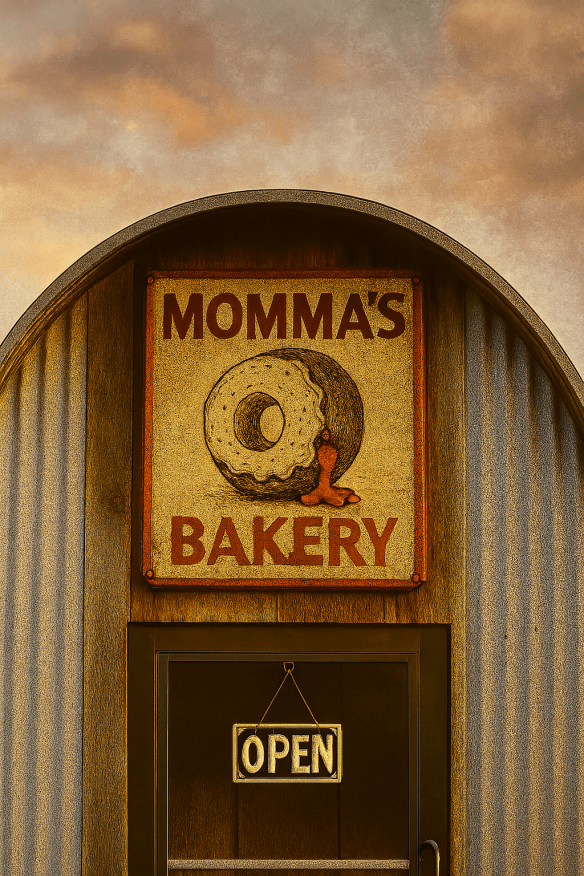
Hallie saw the sign on a bright yellow Quonset hut. It had a large donut with red jelly oozing like a waterfall, and it read Momma’s Bakery. Her stomach growled.

“I’m going to grab something to eat. Is that alright with you, Marlin?”

“It’s Martin. I don’t have any money. Are you paying?”

“Not for yours, sonny. Maybe you could wash some windshields. Or better yet, sit in the car.”

Hallie pulled into the gravel lot. She had barely parked when a reckless driver in a fancy roadster splattered her car with gravel. Hallie opened her door, just missing the man’s custom Vette. She looked back at Martin.

“Marlin, is that who I think it is?”

“Looks like that dweeb from Channel Five, Lance Strong.”

“Maybe this isn’t such a dud, Marlin. He wouldn’t be out here to see his Aunt Tillie.” She looked at Lance, who was on his cell phone and didn’t realize she was alive.

“Alright, here’s the plan. I’ll go in and make some small talk to see what kind of scoop I can get. You don’t want to seem excited in front of another reporter.”

“Makes sense, some kind of way,” Martin said. “You want me to come with?”

“No. Stay here. I’m incognito,” Hallie said, turning and heading for the bakery. Lance Strong looked up, but he didn’t seem to recognize her. Of course, he didn’t; she was nobody.

Martin Fishbein watched his mentor. She was a middle-aged woman with attractive legs and wind-tousled hair. All she needed was a matching babushka for her denim jumper. But I like her, he thought. She seems so genuine.

Glass cases lined the worn linoleum floor, showcasing a variety of colorful donuts. A red-faced man stepped out from the back room, wiping his hands on his apron.

“Help ya?” The tone of his voice showed he didn’t want to help her at all.

“Yes,” Hallie said crisply. “I’ll have a grilled bagel with a side of fat-free cream cheese, please, and a cup of hot tea.”

“Got no bagels. No tea either,” he wiped a rag across the counter, rearranging the bacteria.

“Just give me any pastry you have, baked or fried—I really don’t care. I assume you have coffee.”

“No prob,” he said, waving the rag toward her. “Aren’t you a little far from Slickerville?”

“Pardon?”

“City slickers, I can sniff ‘em out, ya know.”

“Somehow, that doesn’t surprise me. I think we got off on the wrong fried cake here, friend. I’m Hallie Ruben, a reporter for WQIP.”

“Ah-ha. I’d better get Gussie to toss another batch in the fryer. You gotta be here about the bad doings up north.”

“Yeah, they give me all the crappy jobs.” She accepted the glazed donut and a cracked mug filled with rich brew.

The baker gave her a puzzled look and moved down the counter to assist Lance Strong. Hallie chose the table by the window and took a bite of the pastry. It was heaven.

“What’s the fat content in those?” Lance examined the pastries as if calories could leap onto his waistline just by being near them.

“How should I know? I’d say they’ve got about as much fat as your wife’s backside.”

“Coffee, black—that’s it.”

He sat at the neighboring table, with his back facing her. The phone in his shirt pocket was playing some strange music.

“Lance here.” His voice sounded flat and canned. He looked smaller than on TV and a bit pale now that she got a good look at him. But smooth. Very, very smooth. “I want at least a ten-minute slot for this one, Sam,” Lance Strong barked. “And don’t screw this up. If we don’t nail this down, I will personally see to it that your aged mother dies picking remnants of your ass off the face of the moon.”

He slipped his phone into his pocket, turned, and looked at her. He looked like he was about to say something, then he was out the door before she could whistle Dixie.

“I’ll have two more glazed donuts, please,” she purred. The baker flashed a wide grin. Denture paste peeked above his bridge line, a pinkish pulp. Somehow, being single didn’t feel so bad.

“Around here, some say I’m the guy to see when you want info. Of course, I wouldn’t go spilling my guts to the likes of that one who just left.”

“I know what you mean, sir,” Hallie whispered. “That’s Lance Strong. From TV, you know?”

“Damn, I saw that fancy man from a mile away. I know his kind. I am not talking to someone like him. Now you,” he winked. “That might be a different story, if you catch my drift.”

“Ah, the dead horse. Glad you brought it up. What could be so newsworthy about a deceased horse that would grab a top news anchor’s attention across the county line?”

He looked around the room, then leaned over the glass case.

“Heard it on the scanner an hour ago. It’s not a horse–it’s a kid.”

“A goat?”

“A child. A little one. No one’s saying who it is, though. Just take the road north through town and continue on Cedar Creek Road until you reach Territorial. You’ll be looking for O’Bryan’s farm. Look for the two-track.”

“What’s a two-track?”

“A rut for each tire,” he chuckled. “Rumor has it that it’s a little girl. The cops, they stop for their complimentary, ya know, and I hear ’em. Elmo Carter was blowing off steam to another country boy. Seems a furner is nosing around like a hound dog on rabbit stink.”

“A furrier?” Hallie asked in confusion.

“You know, a furner, from some furn country.”

“Oh, a foreigner.” She smiled. It was like visiting Greece—a whole new language. She felt like she needed a Berlitz course in Backwoods English. “Now that’s very interesting!”

“Good luck to ya’.” He waved his greasy rag, and she imagined a thousand germs splattering on her unprotected face.

Martin Fishbein looked rather surly when she returned to the car. She dug through piles of old newspapers that hadn’t been read until she found the road map. She had frosting on her chin in the mirror.

“I see we had a nice, tidy little breakfast,” Martin’s voice cracked somewhere between bass and tenor.

“I’ve been working. This dead horse is really a kid. A very dead kid. This story could make my career,” she said, handing him the donuts and the road map. “Here, make yourself useful.”

“You’d better hurry. Once the word gets out, they’ll send the real crew.”

“The baker gave me directions, so we won’t need to stop at the police station. We’re going to get the drop on WCRP.”

The road hummed beneath the high-quality tires all the way to Cedar Creek.

“Look!” Martin shouted. “It’s the WQIP crew and WCRP, too.” The police station was the size of a gift shop, and a crowd of gawkers surrounded it.

“We can beat them,” she said and then stomped on the gas pedal. The rogue news crew arrived at O’Bryan’s farm fifteen minutes later. The shoulder was empty, except for one Cedar Creek patrol car. She parked next to it. The insignia was slightly crooked on the door, as if it had been put on as an afterthought. Or maybe it was one of those magnetic decals that peeled off at night and ended up being Bob’s Pizza Delivery.

Hallie opened the road map and figured out precisely where they were.

“Okay, Marlin. We’re going to walk through those woods and see how close we can get to those people over there.”

“You mean that policeman standing next to the guy on the horse out in the field?”

“No, I mean the lion tamer who’s whipping the big cats through the fire hoop at the circus.”

“I see why you’re assigned crappy stories,” Martin said as he packed up his gear. “And I know why you’re single.”


Enter your email address to receive email updates as new chapters are added. Be sure to check your email after to confirm.
No Tour Guides in Hell: Chapter 5, A Midwest Cop Shop

CEDAR CREEK, MICHIGAN
Chapter 5
A Midwest Cop Shop

Detective Hank Bradford searched through a pile of misdemeanors and the occasional felony, looking for his electric bill. Not much was happening in Cedar Creek except for the chaos in the outer office.

“And you have to PUSH the dang button to use the intercom, Sheila. It doesn’t just come on by itself,” Barney Deters shouted. He was Cedar Creek’s beloved Police Chief, so he was forgiven for being a man just a bit too old for the job.

Sheila Crane, the new part-time dispatcher, muttered a response, but Hank couldn’t hear it from his office. He was just relieved because her voice had an irritating nasal quality that seemed to drill into his brain and drain gray matter out through his ear.

“See? Like that,” Barney wheezed, pushing his thinning white hair back. The on-the-job lessons weren’t making him feel better.

“Yes, I KNOW,” Sheila wailed. “I don’t see how I can push that, and then not let the other one pop up, and then the person on the line is gone and…”

The buzzer hidden under the doormat announced a visitor. Hank knew the commotion would be delayed until some unlucky citizen’s concerns were addressed. Still, he was hesitant to go to the reception desk.

Troy Hunsacker was at the counter. Before Sheila could greet him, Esther VanderLaan burst through the door and stood right behind Troy. Hunsacker had a bag of empty beer cans.

“No even-steven trades today, Troy,” Barney admonished. “You go right back to Dell’s and get your money for those danged cans. We speak only greenback here.”

“Man, I need my car,” Troy grumbled. “I was at the bowling alley last night, and Ernie’s Towing stole it. I wanna press charges, too.”

“Just pay the tow fee, Troy. You called them,” Hank hollered from his office doorway. “Don’t you remember? You called them because you’d locked your keys inside.”

“Oh,” Troy said. He looked down at his plastic bag. “You guys don’t have any empties, do you?”

“Hold on, son,” Barney said as he entered his office. When he stepped out a minute later, he was holding a twelve-pack of Zippy Soda cans. “Here. Ernie will be glad to get your heap out of his lot.”

“Thanks, Chief,” Troy said.

Esther pushed Troy aside with her cane. When he didn’t move quickly enough, she prodded him. She wasn’t gentle. Troy obeyed and stepped back.

“BARNEY DETERS.” Mrs. VanderLaan slammed her purple plastic purse onto the countertop.

The phone rang again, and Sheila turned her attention to the switchboard, making a quick escape. Barney stood like a snow-capped mountain—nowhere to hide, with no place to run.

“Why, hello there, Esther. How’s the old rheumatism treating you?”

“Stuff it, Deters. I’m a Christian and you know it,” Esther wailed. She was as deaf as a post.

“I come to tell you there was funny goings-on at the Reverend Carrington’s house last night.” Esther snapped her purse open and grabbed a fistful of tissues. “I swear there’s more comings and goings over there than a common bawdy house.”

“Now, Esther. You know the Reverend keeps a respectable home.” Barney edged toward his office. First chance he got, he’d make a run for it.

“My dog, Sunday, woke me up at the crack of dawn, sniffing and whining. I let her outside, and who do I see pedaling down the street on his bike?” Ester pounded on the counter for maximum effect.

Barney knew she was talking about the town’s most mentally challenged citizen, Fly Carrington. Who just happened to be the helpless child of the widower, Reverend Carrington. He played dumb. He wanted to say, “Hi, Fly.” But he held his tongue.

“Reverend Carrington riding a bicycle?”

“Not the preacher, you old windbag. Get the wool out of your ears.” Esther was shouting, and this wouldn’t seem so strange if she had teeth. As it was, she was barely intelligible with her lips flapping like window shades. Hank peeked out of the office, worried that Esther’s head might start spinning and fly clean off.

“Hey, Mrs. VanderLaan,” Hank said.

“I’m not paying for you to mow my lawn, sonny,” she shot back. “And then, after Fly Carrington came up the road, Mike O’Bryan pulled out of the driveway next to the church cemetery. Now I ask you, what are those two up to in the darn middle of the night?”

“Maybe it was a conspiracy,” Hank said, grinning. He was surprised she didn’t vault over the counter and bash his brains in with her cane.

“I was watching that Carrington boy, Barney Deters. Neat as you please, the little piss-ant opened the basement window and slipped down smoothly. You mark my words; he’s probably out raping and pillaging.” Esther patted her brow with the wad of tissues. “A person’s not safe in their own home ‘round here. Lord knows what that drunk, O’Bryan, was up to.”

“You know Fly’s harmless, Esther. He wouldn’t hurt anyone,” Barney reassured her. “And Mike may tip a few, but he’s got no record.”

“Well, I never. I said nothing at all about your fly, Barney Deters.” She grabbed her purse and slammed the door so hard that it made the calendar on the wall shift askew.

“Looney tunes old broad,” someone whispered.

“Uh, can I cut in here for a minute?” Sheila asked. Her headset hung crooked. Hank grabbed a cup of coffee from the ancient coffee maker.

“Steve’s on the phone.” Brooks was a rookie and the only road officer employed by the City of Cedar Creek.

“And? Well, what? Are you going to tell me, or is this a game of twenty questions?” Barney snarled slightly.

Hank interrupted. “What does Steve need, Sheila?”

“He’s at the O’Bryan place. It’s about that horsetail sticking out of the ground. Turns out there’s a dead body out there.”

“Great Grandma’s panties, can’t they tell the difference between a horse and a person?” Barney barked.

“Well, why don’t you just ask him yourself?” Sheila wished she were back at Thunderdog Lanes, handing out rented bowling shoes that reeked of foot gas.

Barney pressed the speaker button, and Hank came over to listen in.

“Yeah, Steve. Go ahead and tell us.”

“Sir, it’s a little redheaded girl. She’s buried up to the topknot,” Steve coughed nervously. “Sir, what should I do? Over.”

“Hold the fort, Brooks. Don’t let the civvies touch anything. Hank and I will be right out. And quit saying ‘over’. It makes you sound like some rookie jerk.” Barney looked at Hank, who was examining flotsam in his coffee.

“Some evil SOBs got to pull off a big city crime and dump it out here in the wilderness, like we don’t have enough problems,” Barney fished for his keys.

Hank’s mood was downcast.

“This is going to be terrible for the folks around here. We’d better get out there in a darn hurry and act like we know what we’re doing,” Hank said, itching for a cigarette. “We don’t have any missing kids around here, so it must be a kid from another county.”

“Or state. Like I said, if some maniac is dumping victims in our jurisdiction, it makes us look bad. God Almighty, a kid—that’s beyond evil. What’s this world coming to?”

“It’s Armageddon, Barn. Look, they have us surrounded like the Alamo,” Hank said as he stared out the front window. “It’s the scanner crowd. You’d think people would have better things to do than gather around those annoying squelching machines, waiting for the next human tragedy to be announced.”

“At least the press isn’t aware of it yet.” Barney grabbed a few items, including a couple of rolls of crime scene tape. “Hank?”

“Yeah, boss,” he replied.

“Don’t you think it’s kind of strange that O’Bryan was out late last night and a body was found on his farm?”

“I guess it is, Barney. But Fly Carrington bikes out that way all the time. He was out last night as well. Meet you in the car.”

Hank looked around his office and spotted his shotgun propped in the corner with a plastic grocery bag hanging from its sight. He grabbed the weapon, slipped a pack of hidden cigarettes from the drawer, and headed for the cruiser. He ignored the shouts from the scanner buzzards and looky-loos.

“Let’s go!” Hank muttered, slamming the door of the car.

Barney jerked the wheel quickly away from the curb and accelerated.

“Son of a bitch, Deters. You drive like an old man with a hat.”

Barney looked at his friend and grinned. He winked at Hank before letting out a deadly fart.

“Hear the horn?” Barney’s eyes twinkled. “It’s Gabriel calling your name!”


Enter your email address to receive email updates as new chapters are added. Be sure to check your email after to confirm

No Tour Guides in Hell: Chapter 4, Maggie

Cedar Creek, Michigan
Chapter 4
Maggie

Detective Hank Bradford searched through a pile of misdemeanors and the occasional felony, looking for his electric bill. Not much was happening in Cedar Creek except for the chaos in the outer office.

“And you have to PUSH the dang button to use the intercom, Sheila. It doesn’t just come on by itself,” Barney Deters shouted. He was Cedar Creek’s beloved Police Chief, so he was forgiven for being a man just a bit too old for the job.

Sheila Crane, the new part-time dispatcher, muttered a response, but Hank couldn’t hear it from his office. He was just relieved because her voice had an irritating nasal quality that seemed to drill into his brain and drain gray matter out through his ear.

“See? Like that,” Barney wheezed, pushing his thinning white hair back. The on-the-job lessons weren’t making him feel better.

“Yes, I KNOW,” Sheila wailed. “I don’t see how I can push that, and then not let the other one pop up, and then the person on the line is gone and…”

The buzzer hidden under the doormat announced a visitor. Hank knew the commotion would be delayed until some unlucky citizen’s concerns were addressed. Still, he was hesitant to go to the reception desk.

Troy Hunsacker was at the counter. Before Sheila could greet him, Esther VanderLaan burst through the door and stood right behind Troy. Hunsacker had a bag of empty beer cans.

“No even-steven trades today, Troy,” Barney admonished. “You go right back to Dell’s and get your money for those danged cans. We speak only greenback here.”

“Man, I need my car,” Troy grumbled. “I was at the bowling alley last night, and Ernie’s Towing stole it. I wanna press charges, too.”

“Just pay the tow fee, Troy. You called them,” Hank hollered from his office doorway. “Don’t you remember? You called them because you’d locked your keys inside.”

“Oh,” Troy said. He looked down at his plastic bag. “You guys don’t have any empties, do you?”

“Hold on, son,” Barney said as he entered his office. When he stepped out a minute later, he was holding a twelve-pack of Zippy Soda cans. “Here. Ernie will be glad to get your heap out of his lot.”

“Thanks, Chief,” Troy said.

Esther pushed Troy aside with her cane. When he didn’t move quickly enough, she prodded him. She wasn’t gentle. Troy obeyed and stepped back.

“BARNEY DETERS.” Mrs. VanderLaan slammed her purple plastic purse onto the countertop.

The phone rang again, and Sheila turned her attention to the switchboard, making a quick escape. Barney stood like a snow-capped mountain—nowhere to hide, with no place to run.

“Why, hello there, Esther. How’s the old rheumatism treating you?”

“Stuff it, Deters. I’m a Christian and you know it,” Esther wailed. She was as deaf as a post.

“I come to tell you there was funny goings-on at the Reverend Carrington’s house last night.” Esther snapped her purse open and grabbed a fistful of tissues. “I swear there’s more comings and goings over there than a common bawdy house.”

“Now, Esther. You know the Reverend keeps a respectable home.” Barney edged toward his office. First chance he got, he’d make a run for it.

“My dog, Sunday, woke me up at the crack of dawn, sniffing and whining. I let her outside, and who do I see pedaling down the street on his bike?” Ester pounded on the counter for maximum effect.

Barney knew she was talking about the town’s most mentally challenged citizen, Fly Carrington. Who just happened to be the helpless child of the widower, Reverend Carrington. He played dumb. He wanted to say, “Hi, Fly.” But he held his tongue.

“Reverend Carrington riding a bicycle?”

“Not the preacher, you old windbag. Get the wool out of your ears.” Esther was shouting, and this wouldn’t seem so strange if she had teeth. As it was, she was barely intelligible with her lips flapping like window shades. Hank peeked out of the office, worried that Esther’s head might start spinning and fly clean off.

“Hey, Mrs. VanderLaan,” Hank said.

“I’m not paying for you to mow my lawn, sonny,” she shot back. “And then, after Fly Carrington came up the road, Mike O’Bryan pulled out of the driveway next to the church cemetery. Now I ask you, what are those two up to in the darn middle of the night?”

“Maybe it was a conspiracy,” Hank said, grinning. He was surprised she didn’t vault over the counter and bash his brains in with her cane.

“I was watching that Carrington boy, Barney Deters. Neat as you please, the little piss-ant opened the basement window and slipped down smoothly. You mark my words; he’s probably out raping and pillaging.” Esther patted her brow with the wad of tissues. “A person’s not safe in their own home ‘round here. Lord knows what that drunk, O’Bryan, was up to.”

“You know Fly’s harmless, Esther. He wouldn’t hurt anyone,” Barney reassured her. “And Mike may tip a few, but he’s got no record.”

“Well, I never. I said nothing at all about your fly, Barney Deters.” She grabbed her purse and slammed the door so hard that it made the calendar on the wall shift askew.

“Looney tunes old broad,” someone whispered.

“Uh, can I cut in here for a minute?” Sheila asked. Her headset hung crooked. Hank grabbed a cup of coffee from the ancient coffee maker.

“Steve’s on the phone.” Brooks was a rookie and the only road officer employed by the City of Cedar Creek.

“And? Well, what? Are you going to tell me, or is this a game of twenty questions?” Barney snarled slightly.

Hank interrupted. “What does Steve need, Sheila?”

“He’s at the O’Bryan place. It’s about that horsetail sticking out of the ground. Turns out there’s a dead body out there.”

“Great Grandma’s panties, can’t they tell the difference between a horse and a person?” Barney barked.

“Well, why don’t you just ask him yourself?” Sheila wished she were back at Thunderdog Lanes, handing out rented bowling shoes that reeked of foot gas.

Barney pressed the speaker button, and Hank came over to listen in.

“Yeah, Steve. Go ahead and tell us.”

“Sir, it’s a little redheaded girl. She’s buried up to the topknot,” Steve coughed nervously. “Sir, what should I do? Over.”

“Hold the fort, Brooks. Don’t let the civvies touch anything. Hank and I will be right out. And quit saying ‘over’. It makes you sound like some rookie jerk.” Barney looked at Hank, who was examining flotsam in his coffee.

“Some evil SOBs got to pull off a big city crime and dump it out here in the wilderness, like we don’t have enough problems,” Barney fished for his keys.

Hank’s mood was downcast.

“This is going to be terrible for the folks around here. We’d better get out there in a darn hurry and act like we know what we’re doing,” Hank said, itching for a cigarette. “We don’t have any missing kids around here, so it must be a kid from another county.”

“Or state. Like I said, if some maniac is dumping victims in our jurisdiction, it makes us look bad. God Almighty, a kid—that’s beyond evil. What’s this world coming to?”

“It’s Armageddon, Barn. Look, they have us surrounded like the Alamo,” Hank said as he stared out the front window. “It’s the scanner crowd. You’d think people would have better things to do than gather around those annoying squelching machines, waiting for the next human tragedy to be announced.”

“At least the press isn’t aware of it yet.” Barney grabbed a few items, including a couple of rolls of crime scene tape. “Hank?”

“Yeah, boss,” he replied.

“Don’t you think it’s kind of strange that O’Bryan was out late last night and a body was found on his farm?”

“I guess it is, Barney. But Fly Carrington bikes out that way all the time. He was out last night as well. Meet you in the car.”

Hank looked around his office and spotted his shotgun propped in the corner with a plastic grocery bag hanging from its sight. He grabbed the weapon, slipped a pack of hidden cigarettes from the drawer, and headed for the cruiser. He ignored the shouts from the scanner buzzards and looky-loos.

“Let’s go!” Hank muttered, slamming the door of the car.

Barney jerked the wheel quickly away from the curb and accelerated.

“Son of a bitch, Deters. You drive like an old man with a hat.”

Barney looked at his friend and grinned. He winked at Hank before letting out a deadly fart.

“Hear the horn?” Barney’s eyes twinkled. “It’s Gabriel calling your name!”


Enter your email address to receive email updates as new chapters are added. Be sure to check your email after to confirm.
Omega Consensus: No Tour Guides in Hell


The Omega Consensus was supposed to be a source of hope, a blueprint for a better tomorrow. Instead, it became a weapon—twisted, silent, and deadly. Blackmail runs through its veins. Greed drives its pulse. No one knows how long it’s been compromised. No one’s talking. Oil prices spike. Fingers point. And in the shadows, Al Amorta Ujung waits—an extortionist syndicate with its sights set on the throat of the United States. They don’t want money. They want control. And they’re willing to burn the world to get it.

Available in print, but also serialized online to read absolutely free. Chapters drop twice each week on Mondays and Thursdays. Subscribe to receive email updates.

No Tour Guides in Hell: Chapter 3, Senator Willson

ARLINGTON, VIRGINIA
Chapter 3
SENATOR WILLSON

“Harley,” Willson shouted, even though Quinn was only a few feet away.

The valet hung the Senator’s navy suit and picked off errant pieces of lint.

“Sir,” Quinn hissed from inside the closet. “I’d appreciate a little respect.”

“You’re a valet, Harley,” Senator Willson muttered. “And I don’t feel particularly nice today. Hagopian’s crawling up my ass, and I’ve got a—oh, never mind. What the hell are you doing?”

Harley Quinn was furious. “I’ve been your trusted valet for nearly twenty years, and I won’t tolerate your nasty mouth this morning.”

“Shut up. Margreth will hear you,” Willson snapped.

“Do you think she doesn’t know about your plots and power plays? Oh, I know. A signed NDA is in your safe. I’m trembling in my shoes. She’s nobody’s fool, Senator. In fact, she’s been getting a little too inquisitive lately. She could be dangerous!”

“Nonsense. We stay civil. After all, we’re good stock. Well-bred people don’t air their dirty laundry.”

The Senator searched through his dresser, sure he had left some paperwork under his socks.

“Would you like some help?” Quinn found a folder under the nightstand and handed it over. “What would you ever do without me?”

The secure phone rang, ending the small talk. There were three phones on this line: one two feet away on the nightstand, another in the Senator’s private office downstairs, and a third phone rang in the distance, unseen by anyone in the Willson household.

He grabbed the receiver. Downstairs, Margreth simultaneously picked up the hidden phone in the office. Willson flipped through his paperwork, also flashing it in front of a hidden camera that sent a satellite signal directly to Sumatra in Indonesia. Jah Lo was grateful for the change of pace.

“Yes? What is it?” The Senator didn’t like talking to anyone before his latte.

“Will! Barb Hagopian here,” she snapped. “We’ve got a crisis brewing. There’s a meeting of Omega’s Founders at Sanctuary this afternoon.”

“It’s not my fault the program’s crashing.”

“Of course it’s your fault! It isn’t mine. Look at that despicable Underhill creature.”

“Shit.”

“That’s right. You gave him a clone for his personal pleasure, and he’s destroyed the unit. You must be out of your mind, Willson. If this blows the top off the Omega Consensus before we can dismantle the program, I’m going to have your head on a pike.”

“I get your point. I, however, am unavailable. I’ll send my valet. There is nobody else I trust.”

“That’s not acceptable.”

“Well, too damn bad. I’ve got hearings today and I’m the goddamn chairman. How would that look to my constituents and the media?” Willson paced the room.

“Would your constituents appreciate the nature of your collaboration with Richard Underhill?”

Harley Quinn eavesdropped on the conversation; Hagopian was so loud he might as well be in the senator’s left ear. Downstairs, Margreth Willson was scribbling notes.

Jah Lo knew everything; he started Hagopian’s terror campaign with just one call to Sanctuary.

“If that’s your best threat, it won’t work,” Will spat into the phone. “You can’t blow my cover without ending up with crap on your shoes. I’m sending Quinn,” Willson repeated and slammed the phone down.

Quinn skillfully folded a shirt and muttered.

“What?” Willson demanded.

“I’m just a valet, remember?”

“Can it, Harley. I’m not in the mood,” Wilson moved away. “This isn’t my fault. Dammit, it is my fault. I encouraged Underhill, and now he’s more than a hemorrhoid—he’s a goddamned case of terminal cancer.”

Go to Sanctuary and soothe that bitch’s ruffled feathers. I’ll give you a nice bonus. After that, I’ll come up with a plan to erase Underhill from our vocabulary.

“I hate Sanctuary. The place gives me the creeps. Full of those ungodly redheaded clone creatures,” Harley frowned. “And everyone’s so damned serious.”

“Maybe I should send you to the unemployment line,” the Senator snapped. “How’d you like them apples? The top’s blowing on Omega and Hagopian is blaming yours truly. I’ve got a lot to lose.”

“I came with nothing, remember?” Quinn neatly stacked shirts. “It’s that under-the-table bonus I’m looking forward to. You bought my silence, but I’m hesitant to get involved in these government schemes.”

On the other side of the world, a group of soldiers gathered around Jah Lo’s monitor as he watched Senator Willson through a small hole in the Senator’s bedroom wall.

“I can’t stomach the Midwest,” Harley feigned an air of haughtiness. “I’m not flying coach. I always get stuck next to an overdressed show girl or a 90-year-old geezer who wants to tell me their life story. I don’t know what’s worse, the smell of trout mixed with a rank gym shower or an old man who’s sprung a leak in his trousers.”

“You can’t fly Toronado. We can’t risk them discovering my non-credentialed valet going to Sanctuary. And please, try to be discreet, will you?

“You have the Toronado Steel corporate jet available, and I can’t use it? That sucks!” Harley’s black hair was combed straight back like Rudy Valentino’s. “Why not?”

“You better hope they don’t figure this out,” Willson said, a hint of danger in his voice. “It could cost me more than my career. Like my life, Harley. And yours.”

“That sounds a bit dangerous for my liking,” Quinn felt a shiver run down his spine. “I’m just a country boy from South Texas.”

“I thought you said you were from Arkansas.” Willson looked at his aide with suspicion.

“I was just joking,” the valet said. “Of course I was born in Arkansas. But I went to camp in Texas once.”

“Don’t mess with me,” the Senator said, not amused. “Call me when you arrive in Michigan. Just act like you understand what’s going on.”

A small worry nagged at Harley Quinn’s mind, but he couldn’t pinpoint the reason. All these government bigshots were involved in secretive nonsense.

Quinn headed to his comfortable rooms upstairs. Gloria, the maid, was on her tiptoes in the hall, dusting a portrait. Her uniform had hiked up, revealing flawless tan thighs. He cleared his throat; she turned to face him.

“I’m going out of town for a little while.”

“I don’t care if you’re going to the moon,” Gloria said, adjusting her dress. Harley was her least favorite person in the house and she never encouraged him.

“Just an errand for the boss, not that it’s any of your business,” Harley snapped. “I’ll be packing if anyone’s looking for me.”

“Nobody is looking for you, Harley. You aren’t important enough to be seen.” Before he could react, she’d stalked off.

Downstairs, in the Senator’s private office, Margreth Willson snooped around. She replaced the phone in its hiding spot, and no one was the wiser. Except a dark-skinned man in Indonesia, but she couldn’t know that.

Sanctuary. She frowned. It meant nothing to her. She replaced the folders that hid the intriguing phone-in-a-drawer setup.

As she examined the contents of dear William’s desk, the phone rang again. This time, she ignored it and kept rummaging through the memos and directives in the top drawer.

At the very back was an envelope bearing a Top-Secret seal. It had already been broken. Margreth pressed the packet against her modest bosom and edged toward the door. She was nervous but determined. She peered into the hallway, searching for an escape route.

“And when the Senator says he wants it skinny, use skim milk.” It was Harley shouting at Gloria.

She anxiously waited for silence. If William caught her here, their truce would be broken. Margreth eased the heavy door open. The well-oiled hinges moved silently. She breathed a sigh of relief after reaching the back stairs. Once in the safety of her bedroom, she tore open the envelope and read quickly. Stunned by the contents, she reread the documents carefully, word for word.

I’m hyperventilating; that’s what I’m doing. Too much carbon dioxide—too much oxygen. What the hell—breathe into a bag. Slow down now, breathe into anything!

She grabbed her lingerie bag and tossed the soiled contents onto the rug. Then she gathered herself and took a deep, slow breath until her pulse stabilized. She reached for her private phone and dialed the White House.

“Victoria, it’s me… Margreth. Listen, this is important. I need to talk to you… privately.”

“I can’t talk right now. How about meeting around, say, 8:30?”

“Great,” Margreth sighed in relief. “I’ll meet you at the spa.”

“Go to the Tropicana Room. I’ll tell security to let you through.” The First Lady of the United States didn’t give Margreth a chance to reply before she hung up.

Margreth, having finished the first step of her plan, opened her nightstand. She picked up one of the many pill bottles and popped a shiny blue tablet into her mouth. Even though she knew it hadn’t dissolved yet, her tension eased.

Ten minutes later, Margreth Willson entered the dining room. She appeared calm and composed, at least outwardly.

“Morning,” she said, gliding past her husband. The Washington Post hid his face.

“Umph,” came from behind the paper.

It was just another day at the Willsons’ elegant home. Two people linked by secrets and lies. Danger hovered nearby, but the orange juice was freshly squeezed and the bagels were soft, so neither one noticed that their carefully built world was a train wreck in the making.


Enter your email to subscribe and receive notifications when new chapters are released. Be sure to check your email after to confirm.

No Tour Guides in Hell: Chapter 2, A Mystery

CEDAR CREEK, MICHIGAN
Chapter 2
A MYSTERY

Headlights cast shadows on the trees lining the road. Kowa thought they looked like dangerous arboreal beasts and the road a deadly gauntlet. He drove quickly to reach Sanctuary before dawn. Kowa turned the crackling radio tuner until strains of Bob Seger filled the night.

“Working on my night moves,” Kowa sang along. “Trying to lose those awkward teenage blues.” He was terribly off-key, but he didn’t care because it helped him drown out the feeling of sinking into a deep pond of moral muck.

He didn’t want to go back to Sanctuary, but he didn’t dare run away. Too many of his friends would be punished if he were to do so.

“Go and pick up the body,” he’d been told. “Bring it back here so the nosy parkers don’t get their hands on it.” So, he did it. But he remembered a little girl named Azara. She was born about a month before Kowa left Sumatra. He replayed the scene at Underhill’s house, where the huge bed seemed to swallow the tiny body.

Underhill stood in the corner as if he had committed the worst of sins; something a normal man wouldn’t do. But the child had no marks on her. If she did, Kowa would have killed him right then and there—no matter the consequences.

The music helped distract him, so he hummed along. He thought of all the people he missed back home.

Suddenly, like a lightning strike, the car hit a deep chuckhole and swerved toward the ditch. Kowa fought for control and managed to avoid flipping over. A hubcap clattered off and rolled like a coin down the road, as if it knew enough to run away.

High in the branches of an old oak on Mike O’Bryan’s Farm, Fly Carrington perched like an owl.

He was a man-child, the village idiot of Cedar Creek, but no one was cruel enough to say that to his family. He pulled his Super G-man periscope out of his sack of treasures and focused on the redheaded stranger struggling to get out of his car. It was listing badly, almost overturned.

Fly scrambled down the tree like a monkey and ran to the edge of the field.

“Hi Fly,” he yelled.

The stranger turned, and Fly backed up warily.

“Hi, Fly?” the strange man repeated.

That was the full extent of Fly’s vocabulary, and everyone knew it. But apparently, this stranger didn’t get the memo.

“Hey, you,” Kowa shouted. “Get over here. Give us a push, eh?” Fly looked suspiciously at the man. He’d never seen him before.

“Hi Fly,” he shouted back.

“What? Are you drunk?” Kowa shouted. It wasn’t his tone but his edgy demeanor that made Fly nervous.

“Hi Fly,” he repeated.

“Get out of here,” the stranger shouted.

Startled, Fly started running because when his father said that, he meant his fist was going to land somewhere painful.

Moonlight shimmered on sentinel trees, bathing the fallow field in soft light. The tall grass swayed with the breeze. Kowa stretched his shoulder to relieve a kink. It was sticky and humid, and his shirt clung to his back.

Fly had moved back to the oak tree and looked at Kowa through his periscope. Nothing interesting was happening, so he went back to his girlie magazine.

He kissed Miss October. She had already endured a lot of affection, and her face looked a little blurry, but that was okay. Father’s lectern was filled with more girls, hidden beneath a stack of sermons. Fly just wanted one more look. Unfortunately, his flashlight was dim, and the moon didn’t shine through the leafy branches.

Kowa was buried in his own problems, which seemed to get worse by the minute. He had forgotten Fly, too distracted by his broken car and the dead body in his trunk. He pulled out a cell phone from his pocket and called Sanctuary.

“Hey, Onu,” Kowa said. Fly could hear him, but the conversation was of little interest.

“Yeah, where are you?”

“I’m somewhere outside Cedar Creek, and I’ve got a flat.”

“So, fix it,” Onu replied, as if it were that easy.

“Can’t. The whole damn wheel is busted. You better send the chopper.”

“Okay, Ace. Try to stay under the radar, all right? We don’t need any more trouble. Hagopian’s out for blood.”

“Thanks, I feel so much better,” Kowa said and hung up. He opened the trunk. A light flickered on, revealing a rumpled bundle. He’d better be ready when the chopper lands. As Kowa lifted the blanket-covered body, a pale hand and foot dangled freely.

Fly blinked. “Hi Fly!” Fly scrambled to get a better view.

Kowa looked at Fly, and the fool froze.

They both heard the rumble of an approaching truck. Kowa ran with his load, crossing the ditch and climbing over the knoll. With a roar, a tow truck pulled off the road, chains clanging.

On the other side of the hillock, Kowa stumbled and dropped his bundle. The coverlet unfurled, and the naked child silently slid down the slope.

Charlie Garrett, the driver for Ernie’s Towing, backed his truck up to the disabled car and inspected it. It was lodged deep in the ditch with a bent rear wheel. The radio crackled loudly with static, and Charlie reached in and grabbed it through the open window.

“What do you need? You’re waking the dead out here.”

“Where the hell are you, Charlie? Flushing toilets at Johnny’s Bar?”

“No, you son of a bitch. I’m out by O’Bryan’s place.”

“We got a call at the bowling alley. Troy Hunsacker locked his keys in the car, and he’s drunk.”

“Call Hank. Troy needs to stay in the drunk tank. I’m not letting him puke all over my truck again. There’s a black four-door parked near Catawampus in the ditch out here.”

“Are there any injuries? Do you need an ambulance?”

“No driver here,” Charlie checked under the car with his flashlight to make sure he hadn’t misspoken. “Must have walked on up to O’Bryan’s place or caught a ride.”

“Pull her in. And get the load out of your pants — time’s money.”

“Yeah, I’ll bring ‘er in,” Charlie hollered back. He gave his ample backside a good scratch and threw the radio back through the window.

Dad gum sums of bitches. I could be playing poker down at the Moose over a brewski instead of driving this sorry-ass tow.

The disabled car was quickly connected to the cable rig. With a clatter of chains, Charlie Garrett drove down the road.

Kowa scooped up the blanket and the child’s pale body in a single motion. The moonlight reflected off his red hair. Miss October was forgotten as Fly watched the man carry his snowy bundle across the field.

Sorry, kid. I’m going to have to bury you. But we’ll send a team to pick you up later. I can’t risk another encounter. Jesus H. Christ, you’d think a rural road like this would be deserted at this hour of the night. It’s Grand Central Station around here.

Kowa knew he was talking to himself to hide his anger and pain. The moonlight bathed him and his burden in a warm glow.

When he looked down at Azara, he was almost breathless from his deep sorrow. Her long, auburn hair was wet with dew, and her eyes were closed. She might have been his sister. Hell, she was his sister. They both came from Natagna.

Shifting the load, he moved toward a clearing in the overgrown field. Several times, he turned, thinking he’d heard something. There could be no more mistakes; otherwise, they’d all pay.

Woodland creatures scurried in the darkness. Coyotes howled. The ground in the clearing was soft. He took off his shirt; moonbeams reflected off a shiny disc hanging on a chain around his neck. His well-defined arms glistened; tonight’s work had just begun.

He used his shoe as a shovel and feverishly dug a shallow grave. Kowa gently laid the child’s body down, like a father would. He stroked her hair once before covering her with loose soil. Reluctantly, he tamped down the dirt and dragged dried stalks and dead branches over the fresh grave.

A burn barrel sat in the middle of the clearing. He pushed it to the edge, leaving an unlikely monument at her feet.

“Goodbye Azara,” he whispered. “Goodbye Sarah. Goodbye E20028.” He glared at the hunter’s moon—bright, distant, and clear.

“How can life be so beautiful and so ugly at the same time?” he asked into the night. He received no answers. It was a lonely vigil in the moonlight for a child he barely knew.

The owl’s hoot broke the spell, and Kowa shivered. He hurried back to the road with Azara’s blanket draped over his bare shoulders. He carried his filthy suit coat and shirt. The dirt in his shoe was a gritty reminder of the grave.

Kowa shrugged off the feeling that he was being watched and continued down the road. Fly examined the blanket-monster closely. There was no movement from that area.

The stranger was jogging now, his white cape flapping wildly behind him. In Fly’s opinion, this proved he was either a vampire or a superhero. The dead body was the clue. He must be a vampire.

Fly pulled a roll of Bite’Ems from his breast pocket and popped two candies into his mouth. The night couldn’t possibly hold more surprises. Then, a distant rumble turned into a deafening roar.

The whup… whup… whup of helicopter blades stirred up dust and debris through the woods. Fly shielded his eyes. A searchlight swept across the tree line.

Fly watched the helicopter hover over the road. In one final display of the supernatural, the vampire soared into the sky with his cape flapping. Then, he was magically pulled into the belly of the craft.

Just before dawn, Fly dropped to the ground. The field was covered in eerie fog. He pulled his bicycle out of the underbrush and looked back at the clearing. Then, he rode as fast as the wind.


Enter an email address to subscribe and receive notice as new chapters are added. Be sure to check your email after to confirm.

No Tour Guides in Hell: Chapter 1, Bad Smells and Fairy Tales

Here is chapter one of our serialized novel. If you missed the prologue, you can find the link for it on the table of contents page.


CEDAR CREEK, MICHIGAN
Chapter 1
BAD SMELLS AND FAIRY TALES

“Willson Estate.” Digby’s deep baritone startled Richard Underhill.

“I want to speak to Senator Willson. Now!”

“The Senator is indisposed, sir.” Digby Brown felt his butler’s job was an endless series of never-ending tasks that involved nothing but dumbbells and nincompoops.

“Would you like to leave a message?”

“No matter where he is, or what he’s doing, you tell that old sack that Richard Underhill wants to have a chat.” Underhill’s voice was annoyingly whiny.

“Are you a constituent, sir? Because I can give you his Senate Office number.” Digby then started the list he’d repeated nearly every day to upset Virginians wanting to complain about a government screw-up.

“Listen, Jeeves, and listen carefully. You tell Mr. High and Mighty that Richard Underhill has a situation.” Richard looked down at Sarah. The dead child was curled up on his bed. “You tell him to take this call if he wants to keep that fancy-ass title of his.”

“Can you hold, sir?” Digby had already pressed the record button to start the machine, just in case the FBI needed to hear this. “I’ll see what I can do.”

“Yeah, Jeeves. Do that. Go ahead and fetch that old SOB,” Underhill settled onto the pillows next to the dead child. “I’ll wait right here.”

Digby poked his head into the library. The Senator was deep in conversation with Senator Armitage.

“Sir, I hate to bother you, but there’s a fellow named Richard Underhill on the phone, and he seems eager to speak with you.”

“Blast!” Senator Willson jumped out of his chair like a jack-in-the-box and ran across the room. Percy Armitage looked angry; he didn’t like to take a back seat to anyone.

“I take it you want to talk to this Underhill person?” Digby whispered.

“Yes, damn it,” Willson growled, then turned back to his colleague.

“Excuse me, Percy. This could be very important.” As he hurried down the hall, the Senator snarled, “Digby, get Percy a scotch.”

When Willson reached for the phone, he hesitated. He knew whatever it was Underhill wanted could be a potential political land mine. He pressed the receiver to his ear.

“This better be good. You are one sick, bloodsucking bastard,” Willson hissed.

“Well, well. It appears that some tension is present. I have a bit of a dilemma, Senator.”

“What’s that? Spit it out, Underhill.”

“That’s not a nice way to talk to your favorite blackmailer, Senator,” Richard said in a somber voice. “It’s a good thing I don’t hold grudges. It’s about the kid you got for me. Just like Humpty Dumpty, the stupid little girl broke into a million pieces. I don’t suppose you can get me another.”

“You are a perverted little runt,” Willson hissed. “I’m not getting another innocent child for you to torture. My God, what have I done?”

“There’s no need to get personal, Senator. I think you’ve forgotten who you’re dealing with.”

“You creep. I know exactly who you are: a short, balding pervert who can’t get over being called freak face in elementary school. Do you think it’s fair retribution to ruin a child’s life? Now you’re a murderer.”

“I swear I didn’t murder her. Shit, I’m a lot of things — evil things — but not that.”

“You have no idea who you’re dealing with, Underhill. We’re both involved with some dangerous people, and we’re in serious trouble.”

“Willie, it was just an unfortunate accident. Someone’s got to get this dead kid out of my house—a little clean-up operation, if you don’t mind.”

“Don’t call me Willie—ever. I know you have an emergency card for that child. It tells you exactly what to do if she gets sick or dies. Find that card in the crawl space where you live and follow the instructions. I’m done dealing with you.”

“Do you want everyone to know about the Sunshine Boys Resort? Like, say, your constituents?”

“Don’t threaten me. I have people who can make you disappear.” Willson slammed the phone down and slid a nitroglycerin tablet under his tongue.

The pain in his chest had been worsening lately. It took two tablets before he could join Senator Armitage to discuss strip-mining in Appalachia.

On the other end of the line, in rural Southeastern Michigan, Richard Underhill sat holding the dead receiver.

“Crap on a cat,” he muttered. “Where the hell is Emily when you need her? Oh yeah. The bitch left.”

His wife wasn’t coming back, that was obvious. It was hard to believe she found such courage somewhere, packed up her two boys, and left.

This is entirely her fault. None of this would have happened if Emily had been here. She’s like that emergency brake the train engineer pulls. Without her, I have no control over my accelerator. How’s a guy supposed to curb his primal urges without some whiny bitch to hold him back? This is her fault.

He went to the closet and searched through the shoes until he found the lockbox hidden beneath the floorboards. The box was heavy, filled with evidence of his past sins. He opened it carefully, as if some of them might escape.

If it’s not here, it’s in the basement. Those sons of bitches gave me papers for this kid. But where did I put that damn emergency card?

Hearing a noise, he looked back at the bed. The lifeless body still lay there; her eyes rolled back in her head like a creepy baby doll. He walked over and prodded her. She didn’t flinch.

You wouldn’t think they’d be so damn fragile. I finally got rid of the wife and have a little free time, but the kid takes a nap on me. Just dandy. Maybe I should snatch that friend of hers. Maggie’s a cute little thing — but I think her mom is onto me. Better not. Right now, I’ve got to get rid of this body or it’s going to stink like an outhouse in here.

He went back to his box, digging through the papers with his dirty, tobacco-stained fingers. He retrieved the card he had hidden recently and sat on the bed’s edge beside Sarah. He gazed at her peaceful face, noticing a faint smile that irritated him.

“Not much to laugh about now, huh?” he said, giving her a quick nudge in the ribs. Hooha, a stuffed bear, escaped her grip and hit the floor, leaving behind its signature glob of fluffy white batting.

Richard grabbed the phone and dialed the long-distance number on the card. As it rang, he drummed his fingers on the nightstand.

“Hello?” Jah Lo’s voice was that of an angry Asian male.

“What the?” Underhill said. “Where the hell am I calling? You sound like you’re in China.”

“Who is this?”

“Richard Underhill.”

“I don’t like your language, Mr. Underhill,” Jah Lo snapped.

Richard shot back, “I don’t like your accent.”

“You are calling about what number?”

“Number? I don’t know.”

“On the neck tag, I require the ID number.”

“Oh, sorry.” He awkwardly held the dead child in a strange dance, shifting her until he found the medallion. “It’s E20028. I believe you called her Azara, but I refer to her as Sarah. Is that what you want?”

“Mr. Underhill, from Michigan. That’s in the States, isn’t it?”

“Yes, of course. Who are you?”

“Al Amorta, Mr. Underhill,” Jah Lo said. “What brings you calling?”

“Well, Al, it looks like I have a dead kid on my hands.”

“That’s too bad for you. We’re happy to help, but you need to follow our instructions exactly if you want to see the sunrise.”

“You can’t talk to me like that. I’m a friend of Senator Willson’s.”

“We can talk to you however we want. You see, my American friend, you have unfortunately reached the headquarters of the Al Amorta Ujung. Please don’t move. I will call Sanctuary and send a unit to retrieve the clone’s body. I’d suggest you not to defy us.” He clicked off.

Richard Underhill waited beside Sarah for a long time until he heard the crunch of gravel in the driveway. He was scared, and Dicky Freak Face didn’t like feeling afraid. Not one bit.


Enter your email address to subscribe, then check for our confirmation email in return. Keep up to date on every post in this series.

Omega Consensus: No Tour Guides in Hell, Prologue

This is the first installment of the serialized novel, Omega Consensus. Subscribe at the end of this post to receive automatic updates as new chapters become available (twice each week).

PROLOGUE

From behind a boulder, George Ho shielded his eyes. A small cloud of dust rose on the road; a faint low rumble could be heard. Someone was approaching, coming this way.

“Son of a bitch,” he muttered, glancing behind him. Thankfully, his granddaughter, Aimee, was out of earshot. His grip tightened on the shotgun, and though he didn’t raise it, he was ready.

“I haven’t seen action like this since the old days,” Ho murmured.

The motorcycle came to a sudden stop just twenty yards from him, kicking up loose gravel. The helmeted rider looked quite unfriendly, and George was hesitant to face a confrontation. The old man was not much help, even with a weapon. He backed up the sidewalk; his foot slipped in the mud. The stranger noticed him.

“Lefty,” the rider shouted. “Hey, old man, don’t you remember me?”

No one called him Lefty anymore, at least not that often.

“Who the hell are you?” he shouted back. “And where did you get gasoline?”

“You son of a gun! It’s been a minute.” The rider tore off his helmet. His once ebony hair now had streaks of white. George relaxed a little. Jake Barnes still wore the rakish grin that made Senator Willson’s wife swoon.

Jake slammed his kickstand into the dirt, leaving his bike amid a cloud of dust hanging in the air.

“Well, I’ll be. Jake, you old hound dog.” George’s voice wasn’t friendly, nor was it a snarl. “What in the Sam Hill are you doing in Utah?”

“Little of this—little of that. Doing odd jobs on the side,” Jake smiled.

George Ho gave his old colleague a once-over. Jake didn’t look a day over 40, and that was a mystery.

“You been taking a bath in the Fountain of Youth, boy?”

“Nah, I’m pretty much over the hill. These old bones ache like a bad tooth.” Barnes brushed off his pant legs and sat on a mossy berm along the creek bank. “I heard you’d settled out here. It’s nice.”

“Yeah, it is. Where on God’s earth did you find gasoline, you shifty son of a bitch?”

“I’ve got some friends who got lucky. We have a supply that should last for a while.”

“I haven’t seen gasoline in years—land sakes, it’s been five years if it’s a day.” George walked over to Jake’s vintage Harley and ran his hand along the engine—it’s as hot as a damn cook stove.

“Haven’t heard the sound of an engine in so long; I almost forgot what it sounded like.”

“Gasoline is very scarce. You’ve got to trade a lot of goods to get a gallon. It doesn’t matter, though. Not many folks have a working vehicle anymore. When I passed through Tennessee, I saw a family living in a pile of cars welded together. Made quite a cozy little cottage.”

“That’s strange. Someone’s newfangled idea of a mobile home, I suppose.”

“You can’t fully understand people. Did you know some are living in dugouts carved into the side of a hill? Guess they don’t have to worry about a twister destroying their home.”

“Great idea for hill country, but some parts are really flat.”

“True, but an old cellar works for them. A bit on the dark side, but what the hell. How are you doing, Lefty? Are you well defended?”

“I can’t get used to that Lefty thing. Nobody’s called me that in years. Why do you ask about defenses, Jake? Are you planning to raid our canned peaches? Or are you after bigger game—like the old days?”

“There are bands of thieves and troublemakers around here, Lefty,” Jake’s eyes narrowed. “I don’t remember you being squeamish about a little violence now and then. Back in the day, you were a pretty good shot.”

“You’re out of line, Jake. The old days are gone. Nothing much happens around here. We’re a peaceful group. Sometimes an outsider comes looking to steal a cow or pig, but mostly folks just keep to themselves.”

“The Eastern Reserve has reinstated the mail system. Do you all have it?”

“Nope, word of mouth works just fine for us. I don’t miss it—no bills and no damn tax man. The government snoops are out of commission, no offense, of course.”

“Sure, none taken. I heard Nick Blake lives around here. Have you seen him?” Jake kept his voice steady, so no inflection would tip the old man off.

“He’s around. Been working on setting up a new government. He’s gathered quite a few young guys for a Western Reserve militia.”

“Do you know where I can find him?”

“Maybe. He’s still the big boss. I guess once a President, always a President. He doesn’t have a title yet because we haven’t ratified a constitution. Funny thing is, these days people don’t care much for politics, which makes it hard to get them to leave their fields.”

“I’ve heard that. People say Blake is an approachable guy.”

“He rolls up his shirtsleeves and bales hay like the rest of us.” George watched as Jake took off his boots and submerged his feet in the murky water.

“Jake, lift your feet up.” The detective in him came as naturally as a burp after a cold beer. George’s fingers clenched around his gun. He felt like Lefty Ho again.

“Why?” Jake asked, but he quickly pulled his feet out of the water anyway. His cuffs spilled their water, and his strong calves looked shiny. The old man’s eyes locked onto Jake’s foot, and he turned as pale as an Asian man can get.

“You aren’t Jake Barnes,” George Ho said. He stood and aimed at the stranger who looked like Jake’s twin. “Who are you?”

“I’m Jake. I recognized you, didn’t I?”

“Get off my land,” George ordered. “Get your ass off my creek bank and haul that Harley back to whatever Hell you rode in from.”

“You’ve turned into a real gasbag, Lefty. I guess you deserve everything you get.” Jake shoved his wet feet back into his boots. He stomped off and mounted his dirt-encrusted road bike.

“And don’t come back,” George shouted. He fired a blast over the pseudo-Jake’s head. Then he heard a sound behind him and spun around, aiming the gun directly at his granddaughter’s pretty head.

“Good God, Aimee. I almost took your head off. You shouldn’t be here. Get home.”

“Grandpa, you’re such a grump. Why were you upset with that man?”

“That’s not a man,” Ho replied. “That’s a demon from Hell, and I sent him packing.”

“You said he wasn’t Jake Barnes. How did you know?” Aimee persisted.

“Because the real Jake Barnes lost his big toe to a shotgun blast years ago. And unless there’s some new-fangled regeneration technique I don’t know about, he’s what we used to call a dead ringer.” The air felt heavy as Lefty sighed. “That fellow had every one of his little piggies intact.”

The Harley coughed up a cloud of dust. Barnes was gone, winding his way through the hills back to the netherworld.

“Grandpa, are you scared?” Aimee asks as she slips the frog into her pocket.

“Someone walked over my grave, little one.”

He took a deep breath and knelt next to Aimee. “Do you have plans for that froggy?”

George Ho’s twelve-year-old granddaughter was his only child’s only child, Evan, who had passed away. He could see a faint memory of his son’s eyes when Aimee looked at him. His heart ached.

“That creature doesn’t look very happy, Aimee.”

“I’m going to keep him.”

“Don’t you think he might prefer his lily pad over the shoebox in your closet?”

“Oh, Grandpa,” Aimee sighed as the frog struggled.

“Frogs don’t like being shoved into pockets, boxes, or jars. And neither do people.”

“I don’t have anyone in my pocket,” Aimee giggled. “A person wouldn’t fit. Why did that man call you Lefty?”

“He called me Lefty because of this.” The old man waved the stump that used to be a hand with fingers. “Lost it in a mine accident in Angola. Blew my nose pickers clean off.”

“Grandpa, that’s terrible. Anyway,” she said. “Tell me about the Great Fall.” She sat at his feet, her long black hair forming a curtain around her slender, golden frame.

A cluster of gray nimbostrati collided with a black wall of rain somewhere near the mountains. Thunder echoed through the canyon, and the wind picked up.

“See the clouds stirring? It was the same way back then. A thunderstorm was forming, but we were all busy with our lives and got caught without our umbrellas. It’s kind of like what will happen if we don’t get up to the house.”

“I hate storms. Boogeymen come out whenever there’s lightning.”

“In the old days, boogeymen walked among us, Aimee. They were right under our noses”.

“Like Jake Barnes?”

“He was one of the good guys. But I’d bet my next harvest that he’s turned as bad as a cracked egg on a hot day. There’s something nasty afoot.”

“Because he grew a toe back?”

“Exactly. That’s not doable, is it? Plus, there’s been an unsettled vibe lately, and I really don’t like it.”

“Tell me everything about the clones, Grandpa. Tell me about Azara’s Land and Digby Brown.”

“You’d be fast asleep before I was finished,” George replied. “Anyway, I think your mother should tell you. I’m swamped.”

“You’re as unbusy as my frog,” Aimee laughed. The object of her affection was splayed out on a lily pad and looked half dead. “Tell me the beginning, Grandpa. Then tomorrow you can tell me the middle, and the next day you can tell me the end.”

“Why don’t you just ask me why the Earth doesn’t spin out of its orbit and hit the Sun?”

“Okay? Why?”

“I give up. Okay, it all started with a little girl named Sarah, and without her… well, who knows what might have happened? Her death was like a stone rolling down a hill. The whole thing picked up speed and kicked up plenty of debris along the way. Once things started to fall apart, there was no stopping them.”

“Sarah’s name was really Azara, I know that,” Aimee said. “She was a little redheaded girl.”

“That’s true.”

In the distance, George Ho saw his daughter-in-law, Helena. She stood on the back porch, waving her dish towel to get their attention.

“You get home, Aimee. I’ll be there in a minute.”

“Okay, but I want to hear about Sarah and Sanctuary as a bedtime story. And about Natagna.” Aimee rushed to the house, leaving George to wrestle with the dragons of his past.

The old man crouched on the steep bank. The pond reflected the darkness of the sky and his thoughts. He zipped a blade of grass between his lips and tasted the bitterness of the weed. Like a rusty pipe with a slow leak, unwelcome memories seeped into the stew of his thoughts.

He’d been just an ordinary detective. It was a routine murder case. Thoughts of the past dragged him into a swamp of memories that pulled him back to those dangerous days before the Great Fall.


Enter your email to subscribe and receive email notifications when new chapters of Omega ConsensusNo Tour Guides in Hell are added. Be sure to check your email to verify after subscribing.