

SUMATRA BARAT
CHAPTER 26
RAGE OF THE DRAGONFLY
On any August evening in Western Sumatra, eighty degrees feels cool. As Erik VandenHeuvel got ready for bed, there was an unusual chill in the night air. His snifter of brandy stayed on the bureau untouched. His book remained unopened on the chair.
Erik leaned out the window. An Al Amorta soldier walked along the far wall and suddenly turned to glare as if the doctor were an intruder. Erik turned off the lamp so his captors couldn’t see him. There was a knock at the door. Focused on watching the enemy, he chose to ignore it. The knock became more insistent, and he reluctantly opened the door.
Dortha Myers stood in the dimly lit hallway. Wisps of gray hair clung to her face, and she looked almost beautiful in the gentle glow of the half-light.
“What is it, Dortha? It’s late, and I’m bone weary.”
“I can’t sleep. I’m haunted by thoughts of Azara, and I have questions.”
Dortha fixed Erik with a probing look. “My questions need answers,” she said quietly, “and you are the only one who holds them, I’m afraid.”
“Come in and sit down,” Erik motioned. “Would you like a brandy?”
“Liquor is not a proper sedative,” Dortha said, accepting the snifter. “Besides, I’m not hysterical, I’m enraged.”
“Ah, you’re upset with me about Azara?” Erik nodded. “I don’t blame you. I have certainly earned the wrath of God. But I wish Azara was the worst of my sins.”
“That is precisely what I want to discuss with you, Erik. Just what in your past is haunting you?”
“The past and present both trouble me. We have raised children who are perceived as inhuman by the world. They are primates, but they belong to a unique branch of their own.”
“Go ahead. I’m listening.”
“Created from a mix of human and orangutan DNA, they exist in a species limbo—not fully human nor orangutan.”
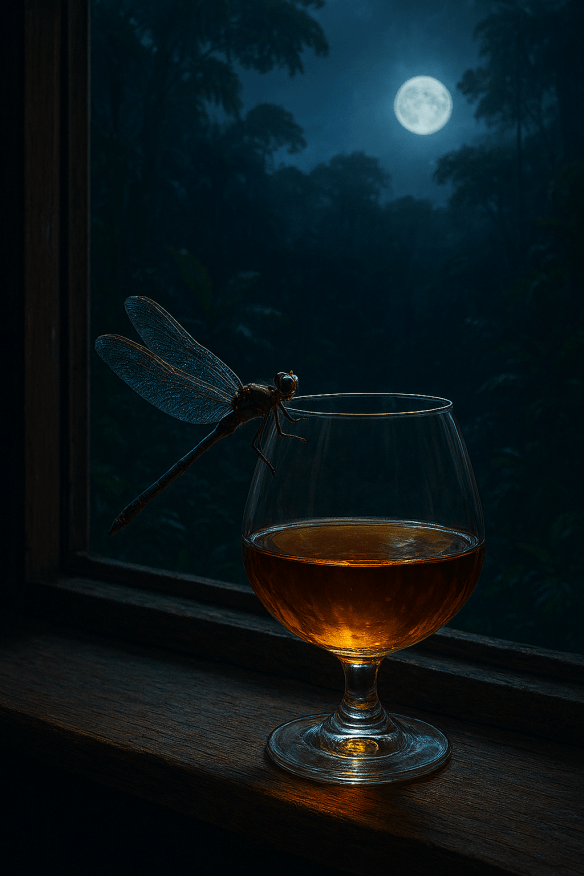
A dragonfly landed gracefully on Dortha’s glass. Erik carefully picked it up and placed it on the window ledge.
“Are you freeing insects as a penance, Erik? I do not think that will save your soul from Hell,” Dortha said. The dragonfly spread its wings and flitted back into the rainforest.
“You do not mistake that dragonfly for a mosquito or a hawk, but some call it a mosquito hawk. Despite the name, he is not in limbo. He belongs to the order Odonata and the suborder Anisoptera. Do you realize how important it is to be properly classified?”
“It is not the clones’ fault. They did not create themselves, Erik. That was your work,” Dortha tossed back the brandy. The liquor burned as it went down. “Now I will become a drunk. That will define me.”
“Why must women be so dramatic? I could not clone human DNA without using filler, could I? I needed to modify the message encoded in certain genes. Most of the time, none of the filler DNA gets expressed.”
“Well, you should have used something else instead of Natagna.” She drained her glass.
“Would you have me use a pig? Instead of sparse hair and a minor throat deformity, Azara could have had bristly skin and cloven hooves,” he mocked her. “Maybe I should have used a frog. Then she would be a green hopping creature with hair like yours. Wouldn’t that make her fit right in at kindergarten!”
“They kiss squeak, Erik. Humans just do not make that noise,” Dortha stopped. Outside, in the orangutans’ enclosure, kiss squeaks filled the night air. “Listen to that. Have you been in school when the children are overexcited? That is what they sound like.”
“Those are minor physical differences. I thought Natagna was an excellent choice,” Erik said. “Not to change the subject, Dortha, but we have much more serious problems.”
“Like Malof’s infection?
“Yes. I believe you’re right that this is the same infection the clones at Sanctuary are experiencing. We need more antibiotics and a specialist in infectious diseases. I’m a researcher.”
“More like a scientist playing God,” Dortha said. She poured the rest of the brandy into her glass without asking. “We played God without any thought about what would happen to these beings. We’re damned, Erik.”
“I once viewed the subjects of medical experiments as less than human,” he admitted,. “That was a long, long time ago. I am much wiser now, but my past plagues me and weighs heavily on my conscience.”
“Are you a Nazi, Erik?”
“I’m not German and I was never a Nazi. But I did collaborate with the Angel of Death.”
“Josef Mengele?” The blood drains from Dortha’s face. “You’re a liar.”
“I wanted to become a doctor, but I was poor. My uncle gave me a chance—an offer to work with a German doctor doing medical research on twins. It paid ten dollars a month. I grabbed the opportunity.”
“Did you know what kind of monster he was?” she hissed at him. “What kind of man are you?”
“I did not realize that when the train arrived at the walled compound. I could see smokestacks belching smoke. How could I know it was burning people?”
“Auschwitz?” she was incredulous.
“Yes. Jews lined up during a death march. The chimneys released human soot into the air. It was a bleak, terrible place of human suffering.”
“My God, Erik, how could you?”
“I did not understand the emotional toll. I wanted to become a doctor. So, I watched and listened. My life was divided between horror by day and, at dusk, going with the Angel to soccer games. Sometimes, we went to the theater. Mengele spoiled me. And I let him.”
“I’m appalled. You watched the selections and did nothing?”
“I could hear his booming voice. He would point left or right as the mood struck him. ‘Zwillinge, Zwillinge,’ he’d shout. I would rush to his side and escort a set of twins to the clinic.”
“Monstrous,” she said. “I can’t bear this.”
“At first, they were grateful for the relief. Mothers handed them over willingly, believing their children had gained their freedom. Later, the twins would pray to join their families in the gas.”
“You mangled children.”
“I helped. I would fill vials with dyes, which he drew into syringes. Then he injected the solution into the iris of their eyes. He aimed to erase their Jewishness, as if their ethnicity was something he could change just with pigment. It never worked.”
“And you can live with this?” Dortha Myers was stunned. “How can you breathe? How can you carry these crimes in your heart?”
“As I said, I have past sins. If it had been done to human beings, it would have been an atrocity. However, these were Jews—vermin, he called them. They were only useful for scientific research, two-legged lab rats. Now, by God, the Creator has his revenge. My children, my creations are viewed the same way. The Americans and the Al Amorta Ujung control the fate of those I love.”
“You are facing the consequences of your actions.”
“There’s no doubt about that,” he admitted.
“How did you end up here?” she asked. “You have never told a coherent story. In fact, you have told so many versions over the years that I’m not sure if you hitched on a tramp steamer or migrated with a Dutch community.”
“I am afraid neither was true, nor any other story I’ve spun over the years. The reality is that I followed Mengele as he fled from the Allied forces. The Americans had us at Hof, and I thought we were going to hang.”
“Then you escaped?”
“No, the Americans made a deal with him; we were released. We got safe passage to Paraguay.” He sighed heavily.
“Go on. I cannot wait to hear about your travels with a butcher.” He knew she would never look at him again with adoring eyes.
“Mengele planned to move deep into Paraguay’s interior and set up a new research center. He wanted to sever his ties and obligations to the United States. We offered paintings and statues that we had stolen from Jews on the illegal market. Here is my final secret, Dortha: I stole a painting. One day, when I was alone in the flat, I packed up the artwork and as many medical files as I could find. I did not look back.”
Dortha wasn’t sure she wanted to hear the rest of Erik’s story, but she couldn’t bring herself to get up and leave.
“I made my way to the coast and boarded the first tramp steamer heading for Europe. I traveled to Vienna, sold the painting to a wealthy patron, and financed my medical education. I became the doctor I had always dreamed of becoming.”
“And then you went to Sumatra to clone people? That’s a really weird twist.”
“The Americans caught me before my medical license was even dry. The artwork I sold was part of the spoils taken from a wealthy Jewish family in Austria. Interpol had no trouble tracing me. My patron gave up my name in exchange for his own freedom. I was forced to make a choice: live and continue Mengele’s work on human cloning, or hang.”
“What about Mengele?”
“I suppose I actually have one more secret.”
“Erik. I’m sorry for you. This burden isn’t one I can carry.”
“The memories are a penance of sorts,” he looked at his gnarled fingers. “These hands have known evil, and yet I thought I’d accomplished good at the end of the day.”
“You sold your soul. Can there be any forgiveness for that?”
“I don’t think so,” he watched the sun peek over the windowsill, feeling weary and weighed down by regret.
Dortha left in silence, hoping that whatever fate he had earned would not rub off. Her heart was breaking, and tears refused to come.
As Erik drifted on the edge of slumber, the fires of Auschwitz consumed his dreams. The smell of burning flesh filled his nostrils as mosquitoes hummed at the edges of his shroud.
Sign up to receive email updates when new chapters are posted.
 Monty & McCluskey